
The Rise of Social Media Marketing and How it Affects Your Local Seattle SEO
Posted by Rory Martin in Social Media Marketing on December 28, 2012
 Seattle is one of the world’s largest e-commerce hotspots, with commercial giants including Amazon, Etsy, Zappos, Groupon, and more, calling the city their home. These companies, like smaller businesses in Seattle, utilize SEO to target local and international traffic, but unlike those big businesses, you as a smaller company have one disadvantage. You’re invisible. In fact, Google doesn’t even see you. Unless you have a reputation, a stake in Google stocks, or happen to be a Google employee, your website or blog is entirely at the mercy of Google’s ever changing algorithms and bots, meaning that you, or the Seattle SEO company promoting your site, must follow the rules.
But what are those SEO rules? Google’s constant release of new updates and changes have left many people confused about correct SEO keyword density, what backlinks are permitted, and now, what social media has to do with your SEO.
Google Algorithm Changes
“There’s been a Penguin update” five little words that are guaranteed to send every webmaster and blog owner scrambling to check their ranking and traffic. The last Penguin update in December of 2012 affected more than 1.6% of queries, and new updates next year could affect more than 6%.
Penguin went live on April 24th of 2012 and with sister Google Algorithm update Panda, proceeded to turn the world of SEO upside down, affecting a combined total of more than 18% of searches. The aim of both of these updates was to lower the ranking of poor quality sites and raise high quality ones to the top of the search. What Panda and Penguin also did was hit any quality sites that were using ‘black hat’ SEO techniques, link farms, or other ‘fake’ SEO. The first wave of changes promoted quality over quantity for both links and content, but changes are not over yet.
The Integration of Social Media and Authorship
In October of 2012, Matt Cutts posted a video on the Google Webmaster Help YouTube channel about guest blogging, explaining that to most sites, the guest blog was obsolete. Posting a great deal of poor quality articles linking back to other sites is only likely to raise a red flag to Google search bots, which would lower the traffic. He then went on to explain that if the author were respected, qualitative, and had a following, the guest blog might be very much worth the websites time. This was the first indication of how the new Google Authorship will affect search engine rankings.
Google created a Google ‘Author’ page earlier this year, allowing site owners to link their Google + to their website or to guest blogs. The result is that persons who utilized authorship could view their search rankings and impressions, and anyone looking for the article could view the authors name and photo with Google + profile just below the article in search.
Now, that Google + profile, combined with Twitter, Facebook, Foursquare, and other social media accounts will be affecting search results. Authors with influence, a history of writing quality content, and a strong niche will soon be ranked above authors without that following, and who write about anything and everything. Social media interactions from company social will also affect search. This new algorithm is beginning to roll out now, and is expected to be fully in place as soon as June of next year.
How New Google Algorithms Affect Your Local Seattle SEO
Whether you’re trying to promote your services or company to the world, or just doing a bit of local SEO, the new Google algorithms affect your results in many ways. With the pure volume of affected search results, you can’t afford to ignore new algorithms, and you can’t afford to ignore your social. Rather than a simple promotion platform, the interaction on your social sites will soon be just as important to your SEO strategy as your content and your back links. International and local Seattle SEO are both affected, so it is important to focus on spreading your optimization through social, quality backlinks, and quality site content.

Better Color Schemes in Web Design and Development
Posted by Rory Martin in Web Design and Development on December 11, 2012
When completing the web design or development process, what do you consider important for search engine optimization and conversion rates? According to Shari Thurow, the one thing you’re probably forgetting, overlooking, or taking for granted is color and how the color of your web content affects its visibility to search engine spiders and the way in which it can convince web users to take specific action.
Thurow says that clickability is one of the primary concerns for web design – so in your color scheme, clickable items should look clickable from the searcher’s point of view. Your users shouldn’t have to mouseover all the text to figure out where to click. And making your links hidden in your color scheme, by not differentiating links from regular text, might be considered blackhat SEO and could be penalized.
Thurow focuses mostly on conversions in color schemes. She explains, white text on a black background is not a good color optimization because it’s hard to visually scan, leading to lower conversions. Also, she mentions the problem of text size since responsive layouts or mobile optimized sites often use a smaller text – which can be interpreted as spam by search engines.
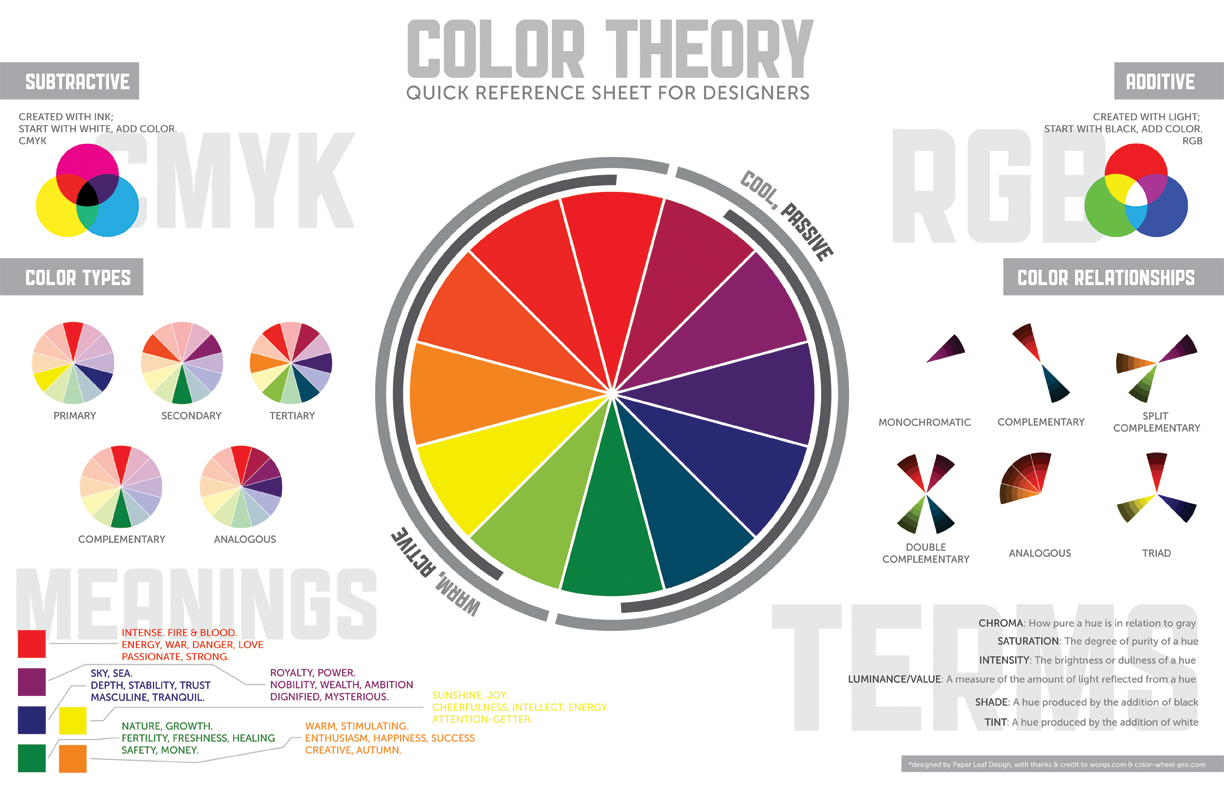
Color theory quick reference sheet – www.icanbecreative.com
In her article, Thurow also stresses the importance of cultural color associations, saying: “the color red communicates happiness in China; anger and danger in Japan; and life and creativity in India.” Designing websites for maximum conversions means knowing who your audience is and designing for that audience. For example, a website for a naturopath and massage therapist likely won’t want to use reds, but will opt for blue instead because of it’s calm, relaxation-based connotations.
A color scheme that works for one website may not work for another, and deciding on a color scheme can be one of the toughest decisions for a designer to make. So how does a good web designer determine the color scheme for a website? Complementation, Contrast, and Vibrancy should be some of the deciding factors in your color scheme.
The vibrancy of the color on your website has a direct affect on the “emotion” behind your design. Brighter colors seem more energetic, which will help invoke an emotional response, whereas darker shades are relaxing, letting the user focus on the content.
Contrast between elements in your web design help drive the focus of your site – drawing attention to certain page elements. You can clearly divide elements on the page to direct the viewer’s eye to certain text, links, or content by just using contrast.
Complementation is a way of building relationships between colors. Considering complementation in your web design, you may want to use split complementary colors (colors across from each other on the color wheel), analagous or monochromatic colors (colors next to each other, or shades of a base color), or a triadic color scheme (using 3 colors on separate ends of the color spectrum – like red, yellow, and blue).
With all this information in mind, how do YOU design web color schemes for SEO and maximum conversion rates?
Reasons a Strong Business Presence on Facebook Matters
Posted by Rory Martin in Social Networking on December 5, 2012
There’s a bit of rift between long-time successful companies and relative startups. Businesses that have been turning a profit and molding their brand image for years are up in the air about whether or not a Facebook presence—or social media in general—is required to achieve success. Newer businesses, however, without the luxury of tenure, insist that it’s a must.

So, which is it? Can you get by without a Facebook presence, or do you really need one in today’s marketplace? Well, that particular question can be argued until the cows finally come home, but as you’ll read below, logic points directly toward having a presence.
5 Reasons to Keep a Solid Foothold in Facebook
1: The Stats are Overwhelming
Over a third of the American population alone uses Facebook. All told, the site has over one billion users, which is going to push a lot closer to 1.5+ once India and other parts of Asia come into the fold. Over half of all Facebook users visit the platform regularly. Trust is growing amongst Facebook fans toward businesses. The stats can go on and on, including the fact that advertising on Facebook cost very little compared to other mediums, and the potential for higher ROI is enormous.
2: A Business-Friendly Atmosphere
Facebook has not only created an extremely business-friendly atmosphere, but one that doesn’t intrude on a user’s experience (unlike MySpace and other networks). With updates like Custom Audiences, Timeline, new advances in their ads via Sponsored Stories, and other measures Facebook has taken to rake in the advertising dollars, the network is currently in the midst of its own boom right now, and no one sees a dropping off point yet.
3: Ways of the World
The world today is trending Internet. There’s no other way to put it. Although Facebook only has a billion users, there are over 5 billion people across the planet who have access to the Internet. As we evolve further in terms of technology, Facebook’s numbers will exponentially increase, as well as Internet activity in general via people handling their shopping online. Any business would be missing out not to ride this train.
4: Adding Credibility
What do you think a tech-savvy customer thinks of your business when they find out you don’t have a Facebook page? (And that’s even assuming they can find you at all without one.) The odds are great that they don’t see you as credible. You’re not a part of the culture they’re a part of, so why would they trust you? Having a Facebook presence works wonders for your credibility.
5: Infinite Traffic Potential
From your business Facebook page, you can interlink an entire web network, including blogs, a main business site, Twitter, LinkedIn, and an infinite number of other sites, profiles and pages. You can reach out beyond your network and work with other businesses to share traffic. You can drive an enormous amount of traffic with a Facebook page (to and from), and there is literally no ceiling on how much you can attract.
Reasons like “free” and “easy” were left off the list, but you can include them as strong factors that may help you make up your mind. The fact of the matter is that your business might not need a Facebook page. But it’s also true that your odds of success increase with one.
Author’s bio:
Eric Taylor works as a freelance writer and business developer for Qwaya, a Facebook ad manager tool. Qwaya provides extensive information, tools and up-to-date news about social media marketing trends and strategies, most specifically on Facebook. The company’s goal is to build and develop a very sophisticated tool with powerful features that are user-friendly and affordable specially for social media marketers world wide.
Put a Public Face on Your Social Media Strategy
Posted by Rory Martin in Social Networking on November 27, 2012
Here at RoryMartin.com, we talk a lot about branding as part of a good social media strategy. At a very basic level, branding is about how we want a potential customer to feel, and what we want them to think, when they see our company out and about – in advertising, on Twitter, being interviewed…
Being interviewed? How can a ‘company’ get interviewed?
When it comes to branding there is one school of thought which believes that people are more likely to connect with a person, than with a faceless corporation. You will most likely agree with this theory, but it’s probable that you will also have ‘good’ feelings when you see a Coca-Cola advert. Of course, Coke have millions of dollars to spend on advertising and marketing, and their branding is all pervasive.
Small to medium companies with rather smaller budgets for getting their brand in front of people may benefit from having a spokesperson or public face of the company. This way, a company can go the usual branding route with online networking and information dissemination but also send their public face out to meetings, networking events, and conferences to relate to potential customers on a personal level. Having a spokesperson, who is represented as an expert in their field, also provides the opportunity for guest-posting, and being interviewed!, on other industry blogs and websites, which then creates link-backs to the company website, as well as positive feeling towards the spokesperson, and therefore the company.
There can be a downside to have a public face on a company, however. Firstly, what if they were to leave the company! Some fashion companies have avoided this by having anonymous public faces, such as @OscarPRGirl who ‘reports’ from inside Oscar De La Renta, and which could be authored by anyone. Secondly, the public face on a company should live according to the company’s ethos at all times when they are in public. As a representative of the brand, it would be hugely detrimental for them to be found acting in such a way as did not represent the brand. This is ultimately quite a responsibility.
What do you think? Do you have a public face for your company? How has it worked for you? Have you ever had any problems with this marketing route?
Linking Businesses Through Social Media Networking
Posted by Rory Martin in Social Networking on November 12, 2012
Have you ever wondered how some small to medium companies never seem to run out of clients, even though you never see them at any networking events? You might be surprised to learn that they do much of their networking from the comfort of their own offices, homes, tablets and smart phones.
Recently, we are seeing more and more often that small to medium companies are scoring new clients and big sponsors through the medium of social media networking. In a time when many businesses are still slow to even jump on a social media platform – or don’t use it once they do – then this information may have many of you shaking your heads. Isn’t social media for listening to customers? For gathering potential customers? Is it possible to make business contacts through social media? The answer to all of these questions is: yes.
Social media platforms are perfect for listening to customers and gathering potential customers, and it is precisely this use which makes it such a great opportunity to reach out to other businesses and potential sponsors, donors and investors. Of course, it’s important to remember that reaching out to potential business contacts, investors, donors and sponsors is no different than reaching out to anyone else. You want to let them know how much you enjoy and value their work, while also providing them with a reason to get in touch with you. At first, this might be a few Tweets which praise a particular ad campaign, or recommend a certain event of theirs. Consistent, but not overwhelming, contact should lead to their notice of you. If your social media audience looks large and engaged, your potential contact will see that your customers and clients trust you. This could be the beginning of a beautiful business relationship…
Have you ever used Twitter, Facebook or another social media platform to find a business contact, sponsor, donor or investor?
How to Plan a Link-Building Strategy
Posted by Rory Martin in Search Engine Optimization on November 2, 2012
You might have heard the phrase ‘link building’ tossed around when new media marketing professionals talk about search engine optimization, and to many, it sounds incomprehensible. How can you build a link? Can you pay someone to link to your site, like an advertisement? Or do you create connections with other companies and bloggers, who might then link to you? The answer is: both of these strategies, and more.

But let’s start from the beginning. When coming up with a link-building strategy, we need to know what we’re aiming for. Which website linking to yours would be the best for your company’s overall business strategy? Shoot for the stars at this stage, because you really never know who might pick up on your content. Once you have a comprehensive list of all the sites you’d like a link from, highlight the biggest. This doesn’t have to be the site with the most readers, but the one with the most authority in your area of expertise.
Now ask yourself: Why would they want to link to us? The answer is already on their site. What kind of content do they currently publish? What do they usually link to? Are they all about fresh new statistics? Unusual ways to make business connections? Graphics about obscure points of code? Try to find a gap in their current content spread – maybe they haven’t covered JavaScript in a while, or perhaps you recently had an employee attend a stand-up comedy workshop for better confidence when giving presentations. Whatever you choose to write about, make sure that you have as much information as possible on this subject. Remember this piece is going to be seen by hundreds of thousands of people, right?
After bringing all the research together, and creating the content, see if there’s a timely opportunity to publish it. Maybe it’s World Comedy Day or World Code Day. These sorts of events mean that people will be looking for content on these topics, and they will be prepared to share them. On a smaller scale, there will be blogs running carnivals, and blogs curating all the posts on these topics for that day, so seek these out and make sure you get a link on their websites. This will make it easier for the bigger names to find you.
Finally, don’t assume that researches on the big name sites, or in the big name companies, will stumble on your content, and don’t be afraid to directly contact the people who you want to link to you. It’s more acceptable than ever to shoot off a succinct and respectful email asking for a link, or even to Tweet at people who might be interested in your piece.
What do you think of this off page SEO strategy? Have you successfully earned a link from a big name site or company? How did you do it?
Get the Most Out of Your Branding – Twitter Cover Photos
Posted by Rory Martin in Social Media Marketing, Social Networking on October 23, 2012
Branding is one of the first marketing steps that a company usually takes. The basic questions asked start with ‘How do we want the customer to feel about our company?’ ‘What tone should the company take?’ Often, the answers to these questions boil down to a few words. Sporty. Out-going. Friendly. Professional. Trust-worthy. Wholesome. Everything which a company then does in terms of marketing, advertising and other forms of publicity and outreach are then done with this brief in mind. This used to be relevant mostly to print media, but, nowadays, we have to consider social media branding.
At the most basic level, social media branding is similar to regular branding. The most instantly recognizable aspect of a business is usually their logo, and this should be used somewhere predominate. For Twitter and Facebook, where users have updates scrolling past them faster than they can read, it’s best to have the company logo as the profile photo. It’s easier to spot a recognizable picture in a list of updates than it is to even skim-read users names.
However, now that both Facebook and Twitter have implemented ‘cover photos’, it’s possible to get creative with your homepage. Your Twitter profile picture will appear in the center of the Twitter cover photo, so using a team photo will often result in someone’s face being obscured – but it might be possible to use this to a humorous advantage. For example, we’ve seen some pretty creative cover “hacks” like this one from Ryan Seacrest
This juxtaposition shows you exactly who Seacrest is in his cover photo. Just make sure to estimate spacing for your tagline and webpage.
The cover photos on Facebook and Twitter are an incredibly useful tool when it comes to social media branding, as businesses are no longer limited to just a 180×180 square company logo. Cover photos can be used to indicate the purpose of the company in a fun and interesting way, or to show people interacting with the company in a positive way.
Have you integrated the new Twitter cover photos into your branding strategy? Check out some quick twitter branding we did for artist, Wyly Astley!
The Dangers of Content For Content’s Sake
Posted by Rory Martin in Search Engine Optimization on October 18, 2012

The Anxious Type by JD Hancock
Content is king! The web is all about content! You must have fresh content if you want to be seen on the new, ever-changing, social web. A lot of advice regarding social media strategies and blogging suggest creating new content every day, setting a schedule to post within, and not deviating from this. This approach does have its advantages – for example, the idea that people will check back every day, or on certain days, out of habit, whether they have seen a social media update informing them of a new post or not. Bloggers and businesses alike promise themselves that they’ll add content to their site as frequently as possible, to keep up the momentum of FRESH! NEW! CONTENT!
However, some content creators, particularly for business, find themselves in danger of creating content without intent – content solely for content’s sake. Sometimes, there isn’t any news. Sometimes, there isn’t anything in the media which even vaguely relates to your field of expertise. Sometimes, there just isn’t anything to say. So, what happens then?
Content for content’s sake is just noise. Content without intent is irrelevant. Content for content’s sake is content that contains very little actual value to readers, and is only there to make your site seem “fresh”, and to beef up your backlinks, or keywords, for SEO purposes. This kind of post seems valuable – fresh content attracts search engines, but it can be off-putting for your audience. Repeat readers will be expecting a post of the usual high quality with relevant, actionable or inspirational information. To come across a boilerplate piece that’s only posted as a means of sticking to your posting schedule and boosting search engine rankings may make them reconsider your value (and where they spend their time on the ‘net).
“Businesses that produce too much information start to appear spammy and scattered. This does not instill confidence in customers and prospects. In fact, it is more likely to confuse them and push them away. Content for content’s sake does not help a business that is trying to be a true influencer in their industry. In fact, it makes you look like the little boy who cried wolf, because when you actually have something important to say, no one will be able to see it through all the other drivel you have produced.”
And it’s true. Everyone re-Pins. Everyone re-posts. Everyone re-Tweets. Google any one phrase and you’ll see a host of websites with that same message. What stands out from the masses of repurposed content? Content that’s relevant, that makes sense, that’s written for humans by humans as a means of conveying facts, knowledge, opinion, and interesting information. And if you don’t have that? Don’t post just because you have to keep your site fresh.
A good way of avoiding this type of content is to read over each piece and ask if you would send it to a stranger as a good representation of your website overall. If the answer is no, then don’t publish it! Readers would rather a blogger miss a few days worth of posts than read through half-baked content. Post when you have something to say – it doesn’t have to be life-altering, but it should be valuable to your reader.
Have you ever skipped a few days of publishing content until you found something worth writing about? How did it affect your website?
Rory Martin Supports IslandWood Outdoor Learning Center
Posted by Rory Martin in News on October 8, 2012
RoryMartin is pleased to announce our support of nonprofit, IslandWood Outdoor Learning Center on Bainbridge Island, in it’s cause to inspire environmental and community stewardship. IslandWood’s methods use technology, scientific inquiry and the arts to inspire Puget Sound-area students and their families to connect with nature and the outdoors. There are a wide range of programs and community events offered for kids, their families, and individuals alike.
IslandWood came about when, in 1997, over 1000 acres of land were put up for sale on the south end of Bainbridge Island. Since studies done around that time showed that half of Puget Sound’s students did not receive any overnight, outdoor education programs, local residence Debbi and Paul Brainerd proposed the idea of a children’s outdoor education center, that would offer a School Overnight Program. IslandWood is a unique way to blend technology and nature, offering hands-on learning to Puget Sounders of all ages.
The School Overnight Programs have been a success, allowing 4th, 5th, and 6th graders to do things like listen for owls in the night, and study 150 year old trees from the top down. In addition, IslandWood partners with the University of Washington to provide Graduate Programs that work towards building a community of knowledgeable and committed educators through experiential and multicultural education.
To help IslandWood reach its of connecting families with the ecosystem they live in, RoryMartin.com has donated to this unique experience. “We’re really excited to be able to help IslandWood continue their nature conservancy programs. We believe these programs will help families gain a better understanding of the natural beauty the Puget Sound has to offer and will help us become more conscious about saving our environment,” says owner, Rory Martin. To donate to the IslandWood programs, click here.
Cultivate Inbound Links by Diversifying your Audience
Posted by Rory Martin in Search Engine Optimization on October 4, 2012
An important factor in search engine optimization is cultivating in-bound links. Links that come to your site from a well-known, authoritative website increase the likelihood of search engines deciding that your site must also be authoritative. This is especially true if the linking site uses a keyword for their anchor text that’s something you offer or something that you want to be known for – i.e. ‘great marketing techniques’ or ‘best sauna’.
There are various strategies for encouraging other sites to link to your website, and they all primarily involve offering them something to link to by way of content, but also giving them a reason to do so.
Many company blogs are well-written, frequently updated, factual and interesting, yet still don’t receive as many incoming links as, say, a less-well written or informative piece about social media. This may be related to the fact that there are just fewer sauna-builders or owners with well-kept blogs or a renowned social media presence than there are social media consultants, who live on the internet.
All is not lost however. The answer here is to appeal to a demographic which builds links. A corporate website that sells and builds saunas could write about working from home, for instance, and ask how people move from work-mode into evening-mode without the benefit of a commute. Finally, they can suggest that readers purchase a sauna with the money they save commuting! Many people who work from home make use of social media, or blogging, as a pseudo-office environment and might get involved in a discussion about after-work decompression techniques.
Something else to think about is language use and structure, especially if you want the media to pick up on your site. Would a reporter be able to link to your site to provide further evidence for their piece? This isn’t to say that you should know what a newspaper is about to publish on, but having a clear title and an obvious slant from the first paragraph, as well as accurate and researched facts should increase the likelihood of a piece being linked to – by anyone, not just the media.
The main factor to consider when trying to cultivate more inbound links is to ask what is in it for the people linking to you. One tactic is to run giveaways which require linking to the site, but consider that many people use their blogs in order to appear authoritative on a subject. Being well-read is one way of appearing authoritative, so make your content as helpful, or factual, as possible, and this will encourage people to link to your site in order to look better-educated themselves.
Have you had any success with building inbound links to improve search engine optimization? What is your preferred method of encouraging these relationships?
Recent Comments