
Posts Tagged manage brand communication
The State of LinkedIn
Posted by Rory Martin in Social Media Marketing, Social Networking on July 12, 2011
Have you ever wondered how LinkedIn actually affects your business? Ever asked yourself why LinkedIn is important to your company’s potential? At RoryMartin.com, we’ve been researching ways for businesses to use LinkedIn to build a better social media strategy.

Having your business profile out there on the web WILL help increase your organic search results, so if you’re not optimizing sites like LinkedIn, you’re not fully optimizing your search engine potential. LinkedIn also helps your business look more complete, and is an established tool for reputation management – especially through customer testimonials.
LinkedIn is also a powerful tool to analyze your company and its connections through your employee network. An article on Mashable notes that, “…it will automatically calculate your company’s median age, top schools, and other companies that they are well-connected to.” This can be effective for recruiting job candidates, and networking in your industry. Through LinkedIn you have the ability to post polls, and receive answers, letting your business know what your clients are interested in, and keeping you up to date on industry standards.
If you’re curious about how to use LinkedIn for your business, contact RoryMartin.com to find a strategy that fits your social networking needs, as well as the social tools that simplify your social media integration. We offer a comprehensive set of services from website design and web development to search engine optimization and search engine marketing and social media marketing. If you need creative ideas, easy implementation, and a limited investment into your social media campaign, RoryMartin.com has experts available to assess your needs, provide excellent customer service and innovative marketing tactics before you’ve even signed a contract.

Deciphering your Bounce Rate
Posted by Rory Martin in Search Engine Optimization, Social Media Marketing on July 7, 2011
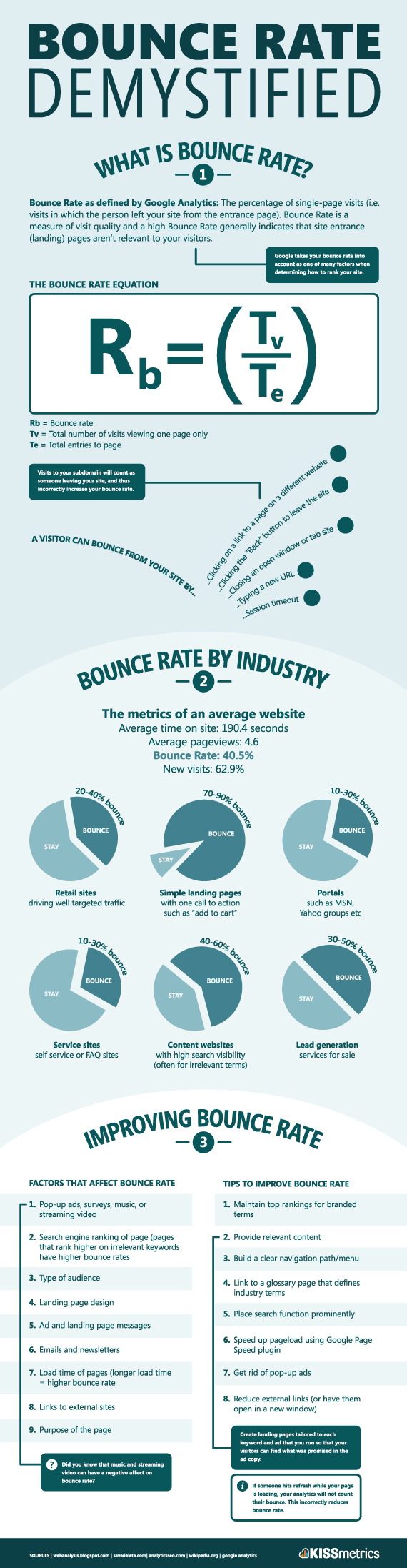
In trying to keep visitors on your site, knowing your bounce rate is half the battle. It can be difficult to determine how your bounce rate is calculated and which factors affect your bounce rate. We found this cool infographic from KissMetrics that shows which factors you can work on to retain visitors, and it even shows the industry standard for your industry. Check it out!
As a Seattle Web Design company that specializes in Seattle Search Engine Optimization and Seattle Social Media Marketing, RoryMartin.com can help you build a Social Media Strategy that reflects your unique brand, draws and keeps visitors on your page. We help implement exciting content and social tools that will make your business stand out. From a one-time site analysis to full search engine optimization strategy and execution, RoryMartin.com can help your business grow.
Time Your Social Media Efforts for Maximum Effect
Posted by Rory Martin in Social Media Marketing, Social Networking on June 30, 2011
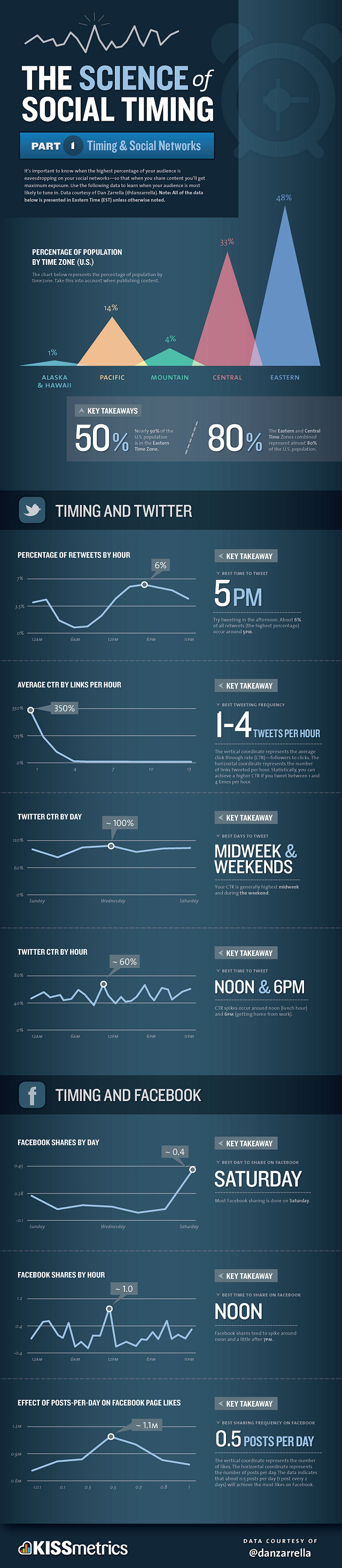
We found a cool infographic on the best times to send out social media posts. We like to couple this with the Problogger strategy for blog postings when we’re considering the best way to send out social media messages. This is a great infographic to keep in mind – especially if you’re using something like HootSuite to schedule your posts. The original post says,
Included are stats for Facebook and Twitter on what days and times are best to maximize the audience size and the possibility that your content will be both found and shared.
As a Seattle Web Design company that specializes in Seattle Search Engine Optimization and Seattle Social Media Marketing, RoryMartin.com can help you build a Social Media Strategy that reflects your unique brand, draws and keeps visitors on your page. We help implement exciting content and social tools that will make your business stand out. From a one-time site analysis to full search engine optimization strategy and execution, RoryMartin.com can help your business grow.
The World, in Social Networks
Posted by Rory Martin in Social Media Marketing, Social Networking on June 24, 2011
We found a cool infographic from Vincenzo Cosenza’s blog (Vincos.it) showing the world in Social Networks. Vincenzo says,
Facebook is slowing gaining users around the world (almost 700 millions) establishing its leadership in 119 out of 134 countries analyzed (in this edition I’ve added Ethiopia and Tanzania).
Europe has now became the largest continent on Facebook with 205 million users…
It’s interesting to look at how these numbers have changed this year.
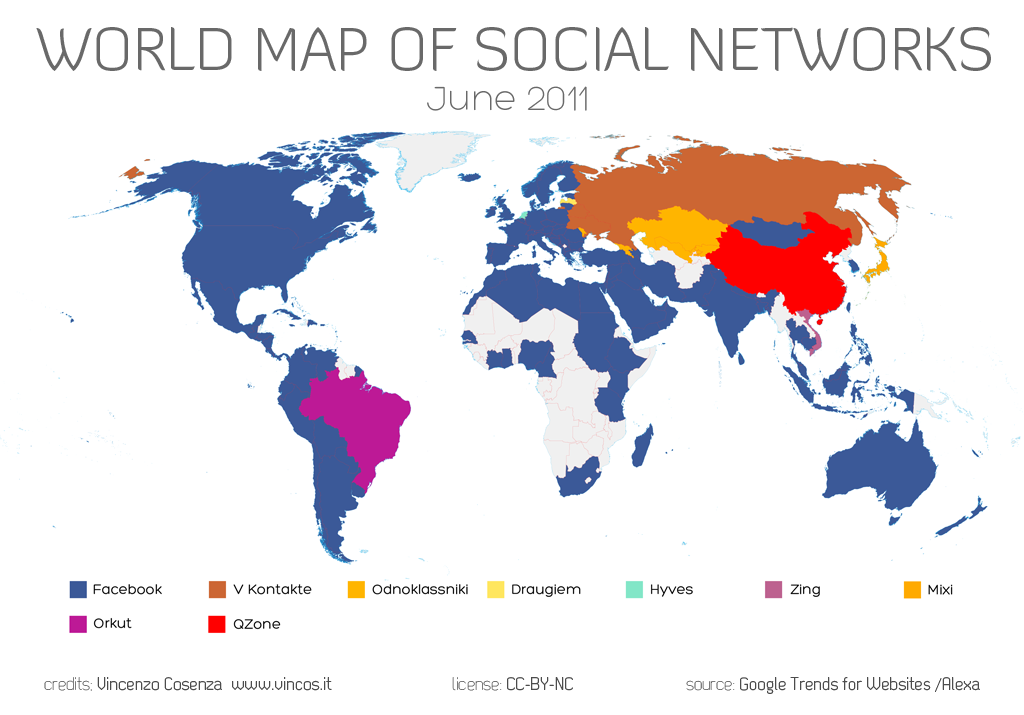
Facebook is by far the social network winner here, so we encourage our clients to make sure they have a solid presence on Facebook and are actively engaging their customers. Need to know what goes into your Facebook strategy? In this article we tell you how to make an impact on Facebook.
RoryMartin.com is that secret weapon that will revolutionize the way you engage with your clients and end-users. We offer a comprehensive set of services from website design and web development to search engine optimization, search engine marketing and social media marketing for companies large and small.
The New Landscape of Social Media Marketing
Posted by Rory Martin in Search Engine Optimization, Social Media Marketing, Social Networking on June 20, 2011
Navigating the new marketing landscape means knowing which marketing tactics are effective, and which tactics are outdated. Improving the visibility of your website has become a marketing priority, yet it can be frustrating since competition for rankings is intense. As many businesses lack the time or cashflow to continuously monitor, report and adjust their strategy, the results of many social media marketing campaigns are often poor. If you’re struggling to boost your page rank, you may need to adapt your SEO and social media strategy to reflect the new trends in social media marketing and search engine optimization.
If you’re not embracing social media as a business, you’re missing out on one of the biggest marketing tools available. Using tools like Facebook and Twitter actually boost your search engine rankings, making your website more visible to search engines like Google. Consider how much content is shared on Facebook each day – users spend approximately 22% of their Internet time in social media, making social media a priority for any company that wants to be visible.
Of course, just hiring an intern may not do the trick. While social media can be a valuable marketing campaign tool, it’s often a commitment. Hiring a professional will ensure that you get the best results from your brand’s digital communications. You want someone who can represent your brand and company, not just the message behind your brand. Social media has become an avenue for customer service, sales inquiries and ongoing questions – you want someone who understands your audience, and can think out of the box in a way that is both specific and familiar to your client base.
Hiring a professional will ensure that your message, and your core product do not get lost in a sea of irrelevant information. Anyone who’s been on the web knows just how much junk the web holds – having a true professional on your team will ensure that your relevant keywords and terms drive traffic to your page. A professional can tell you which information to include and which information is irrelevant. They can help you streamline your content, showing off your product’s benefits in a straightforward way. A social media professional can also help you determine terms that are broad and wide reaching, and help you optimize key words and phrases so that your site gets a good SEO ranking.
Content is still key on the web, and having someone who knows your brand, your clients and your company will ensure that users come to your website because you are an authority. Social media is all about providing something of value to your customers. You need interesting and relevant content, you need high-quality inbound and outbound links. You need customer interaction that is fun and info-rich. Monitoring industry key words and phrases will continually provide feedback on what your customer or audience is interested in, making a tailored social media strategy easier to attain.
RoryMartin.com is that secret weapon that will revolutionize the way you engage with your clients and end-users. We offer a comprehensive set of services from website design and web development to search engine optimization and search engine marketing and social media marketing. If you need creative ideas, easy implementation, and a limited investment into your social media campaign, RoryMartin.com has experts available to assess your needs, provide excellent customer service and innovative marketing tactics before you’ve even signed a contract.
For Social’s Sake: Managing A Brand With Socialized Communications
Posted by Rory Martin in Social Media Marketing, Social Networking on May 5, 2010
Don’t let your brand be a social outcast. Especially in Seattle, NY, LA, and Portland

It used to be that brands sought partnerships with publications to publicize their offerings, host events or write about their products. And many publications did and still do an excellent job at providing these services to help promote a company’s products to specialized audiences. However, the dynamics of buying and selling has shifted the power from the media over to the brand and consumer.
Now, in order to launch a new product, a brand needs to extend its identity in many more channels and to many more audiences. Thus in addition to promoting itself in worthy publications, a brand must have a strategic digital marketing strategy, a solid list of target–and often splintered–consumers, and a multitude of social networks to engage them. Many marketing activities are now direct-to-consumer instead of company-to-consumer. In fact, new research predicts that spending on Internet-based marketing is expected to overtake print ad budgets in 2010 for the first time. For these reasons, traditional media is now adapting to this new marketing reality.
Today’s savvy consumers will respond to a brand that speaks to a need they have identified, resonates with them on an emotional level, or solves a problem that they maybe didn’t even know existed. Brands today are actively harnessing social media platforms to create content and communities to find their brand loyalists or advocates. Once identified and engaged with, brand advocates do the marketing campaigns for them. These brand advocates might enter an online contest to help name a new product or create a new food flavor that then gets produced and distributed. They may select music they want to appear in a videogame. And they can decide to tell all of their friends and networks about how they have taken control of their brand relationships in this new marketing paradigm.
The new model of targeting brand ambassadors is about two-way, open, social engagement and not just top-down and inside-out pushing of products. It is as much from the outside in–from consumers back to the brand. While most brands are implementing social communications programs using one or two social platforms, only a handful are thinking holistically about managing communications across all media and touch points. The requirements are now to communicate who you are as a brand and what you stand for through social media in a far more consistent, strategic and global way. After all, unlike traditional media, online content and experiences are inherently open and accessible everywhere around the world.
RoryMartin.com helps clients educate their markets and build brand awareness while winning and retaining customers with engaging and impactful websites and web marketing. We offer a comprehensive set of services from website design and web development to search engine optimization and search engine marketing and social media marketing.
The Albert Einstein Guide to Social Media
Posted by Rory Martin in Social Media Marketing on February 14, 2010
11 February, 2010 | Written by Amber Naslund
 Albert Einstein knew an awful lot. And if you pay attention to his work and his most famous statements about it, you might just think he was talking about us, the social media crew.
We might not be looking for a unified theory for all things quantum in our day jobs, or pondering the discrepancies between particle theory and relativity, but here are a few things Einstein has managed to summarize for us just the same. Funny how some concepts apply pretty universally…
As a Seattle Web Design company that specializes in Seattle Search Engine Optimization and Seattle Social Media Marketing, I really like this stuff.
A perfection of means, and confusion of aims, seems to be our main problem.
It all starts with the goals and objectives, but look around you, and you’re sure to see the folks that still think the Facebook Page is the holy grail of social media success. Know what you’re aiming for before you choose any one path to get there.
Any intelligent fool can make things bigger and more complex… It takes a touch of genius – and a lot of courage to move in the opposite direction.
We’re hell bent on creating convoluted indexes and formulas to calculate and measure the fuzzy stuff like influence, affinity, or loyalty. As if somehow putting an algebraic formula to it will make it legitimate. Are there simpler ways we can be approaching these seemingly complex problems from a more human level?
Everything that can be counted does not necessarily count; everything that counts cannot necessarily be counted.
You can count a zillion fans and followers but what are you going to do with them when you have them? Are they moving you toward something, or are they just there? And things like having genuine intent or an authentic mindset (not one on a mission statement somewhere) are much harder to quantify and put on a report, but they matter a great deal. They’re part of the untouchable essence of outstanding companies.
If you can’t explain it simply, you don’t understand it well enough.
We need more clarity, accountability, and translation of social media into terms that everyone can relate to. Enough with the buzzwords and lingo already. “Joining the conversation” doesn’t explain anything.
Peace cannot be kept by force; it can only be achieved by understanding.
Teaching and guiding adoption of social media can be an arduous task. But forcing too many rules without context and understanding is a recipe for resistance and resentment. And dragging people unwillingly into the social web before they’re truly culturally equipped will undoubtedly end in failure. Understanding new concepts and ideas takes time, patience, and the willingness of some to make small strides instead of huge leaps.
People love chopping wood. In this activity one immediately sees results.
We all wish that you could just throw up a blog and instantly see a lift in your sales numbers, but it doesn’t work that way. Cultivating a social media community takes more time than many businesses would like. They’re so anxious to know whether they’ve made a good or bad investment, so they demand results and guarantees before they start. But much like the business relationships you’ve built the old fashioned way, creating trust and loyalty is an investment, not a transaction.
Strive not to be a success, but rather to be of value.
In a world where content is everywhere, it’s not enough to just have a bunch of eyeballs see what you do. Value is a wonderful aim, if you understand that value is defined differently for everyone. Your definition of value doesn’t matter when it comes to offering it to someone else. You have to figure out how your customers, prospects, and community define it, and deliver that to them, relentlessly.
We can’t solve problems by using the same kind of thinking we used when we created them.
Social media is, in many ways, a solution to some of the problems we’ve created ourselves. The divide we’ve created between the company and the customer is one of our own design, and social media is helping to shorten that distance again. As a result, we cannot try and cram social media into the same mindset we’ve used for sales, marketing, and customer service for the last several decades, or we’ll just end up right back where we started, and end up blaming social media itself for not living up to our expectations.
Insanity: doing the same thing over and over again and expecting different results.
We collected impressions for ads as if having a million people see a billboard without any notion of what they did with that information was actually effective. We build call centers to automate customer service. We talked in “key messages” and soundbites, and we buried our mistakes under PR gloss-overs. Customers are now pushing back on those ideas and demanding better from businesses. Yet, we’re approaching Facebook as an eyeball collection tool, or Twitter as a press release distribution service, or throwing interns to manage our customer support forums, and we’re wondering why we’re having trouble seeing value in these tools?
Anyone who has never made a mistake has never tried anything new.
We’re talking about new approaches to business problems, here. We’re talking culture shift. Adjustments to our approach, the courage to evaluate our weaknesses, and the willingness to invest in things that aren’t the same as we’ve always done. All that means that mistakes are inevitable. And rather than lynching and publicly vilifying those that fall short, let’s learn from each other, from ourselves, and start allowing social media a legitimate place in business process innovation.
Not bad for a guy with crazy hair who never tied his shoes, but who managed to single-handedly and drastically change our understanding of the universe around us. I’m thinking we can help businesses do the same for the online world we’re creating here. You?
As a Seattle Web Design company that specializes in Seattle Search Engine Optimization and Seattle Social Media Marketing, I really like this article…for more information please visit our site at RoryMartin.com
The Seattle Social Advertising Trends of 2010
Posted by Rory Martin in Social Media Marketing on January 28, 2010
Forecasts and predictions about twenty-ten are EVERYWHERE. We looked deep into our crystal ball here at SocialMedia.com, but it seems someone swapped it for a beach ball.
So rather than try to guess the future, we put together a list of five emerging trends that are already stirring up social advertising. To be successful in 2010, you must plan for how these trends will impact your business.
As a Seattle Web Design company that specializes in Seattle Search Engine Optimization and Seattle Social Media Marketing, I really like this stuff.
1. No stone is left unturned when it comes to finding social data.
Social networks are gaining a larger chunk of online advertising dollars, in large part due to the effectiveness of using social data from these sites to deliver targeted brand messages. But data from social graphs is not exclusive to social networks. As more money shifts to social networks, traditional publishers will want to get a piece of the action.
TAKEAWAY: To offer social data to advertisers, publishers are working hard to uncover and grow their existing social graphs – and succeeding. Don’t get left behind.
2. Social relationships are more than just friends.
At SocialMedia.com, we break social relationships down into one of three categories: friends, influencers, and communities.
- Friends are the easiest to spot; they are a one-to-one connection, approved by both parties (e.g. connections on Facebook, MySpace, LinkedIn, Foursquare, etc.).
- Influencers are characterized by a one-to-many relationship, bloggers and micro-bloggers being the best examples. For instance, a wine lover blogs about new wines she has discovered and others wine drinkers read her blog and view her opinions as a trusted source of information, even though she does not know the identity of all her readers.
- Communities include individuals who are largely anonymous to each other, but relate to the group around a similar interest (characterized by a many-to-many relationship). For example, fans of new TV show might discuss recent episodes in a discussion forum. In this particular case the community may only last for the duration of the television series. In other cases, the community relationship may persist much longer, e.g. moms trading advice on a website dedicated to parenthood.
TAKEAWAY: Because communities have been largely overlooked as a significant social relationships, there is a tremendous opportunity to execute social campaigns on sites other than social networks, where the voice of a given site and/or community is leveraged as a whole. This opportunity appears even more promising when advertisers consider the upward trend of online users embracing social activities and identifying with online communities. (We believe that the nuances of social relationships are so important that we’ll be following up with another blog post that digs deeper into this topic).
3. Consumers turn to online social connections for recommendations.
The rapid growth (not to mention sheer number) of social media users is bolstering the credibility and perceived value of social media channels, tools, and most importantly, content. This larger base of active users allows people to connect with virtual peer groups in more niche categories. For example, a foodie follows a list of local restaurant critics on twitter, a CIO joins a LinkedIn group for IT leaders and discusses cloud computing, an indie rock fan blogs about new bands and other indie rock fans read her posts. These connections are real and authentic (establishing trust) and are hyper-targeted, which means users get highly tailored opinions by turning to these groups.
TAKEAWAY: More open-minded consumers actively seeking advice and recommendations from online peer groups, creates a gold mine for advertisers who can be armed and ready with real brand messages from real people.
4. Online endorsements are happening in real time.
Not only are more consumers using online social connections as an input for decision-making, but when they do they are also finding real-time information from other consumers. Reviews of retail locations are posted before consumers even leave the stores. Bad (and good) customer service experiences are tweeted, blogged, and posted to social networks within seconds, when emotions run highest. And all of the content created in real time is distributed immediately through viral actions like posts, shares, and retweets. Moreover, new services like Aardvark allow users to pose questions via web, chat applications, twitter, or Facebook to get immediate answers from an extended network of peers. What does it mean? Your reaction to real-time reviews must be in real time too.
TAKEAWAY: By monitoring real-time conversations, brands can put out fires, leverage positive endorsements, and participate in the conversation. But that’s just scratching the surface. Brands that go beyond monitoring may find opportunities to initiate endorsements at the time of interaction by providing prompts and channels to leave feedback, thus maximizing positive word-of-mouth recommendations.
5. The objectives of online creative are shifting from consumable to sharable.
As a social online experience becomes the new norm, online display advertising follows. Whereas in the past online advertisers wanted big flashy ads that shouted messages and captured eyeballs, now advertisers want ads that inspire consumers to take action, particularly using social channels to spread brand messages to friends and followers.
TAKEAWAY: Our experience and research at SocialMedia.com has shown that the most effective ads: 1) include real people, 2) spread real messages, and 3) are adapted to the environment in which they are served.
As a Seattle Web Design company that specializes in Seattle Search Engine Optimization and Seattle Social Media Marketing, I hope everybody does this stuff…it’s free and easy.
Recent Comments