
Archive for category Web Design and Development
Five Web Design Elements E-Commerce Entrepreneurs Can’t Afford to Ignore
Posted by Rory Martin in Web Design and Development on February 14, 2013
 If you’re in the business of e-commerce then your website is your biggest advantage. Whether you choose to work with Seattle web design companies like Rory Martin, or to attempt to do everything yourself, you have to know what works in an e-commerce site, and what sends people running. E-commerce is all about conversion which means your site has to load quickly, use converting text, and have plenty of easy to view and load images. You can also choose to use an e-commerce platform like ZenCart or a big e-commerce manager like Big Commerce, but your web design elements matter as well. Here are five elements that your Seattle web designer should be including in your website, and why.
Social and Email Integration
Today is a world of social and if yours is not integrated into your site, you might be missing out on one of your biggest marketing opportunities. Try integrating an email signup box offering a small 5-15% discount on either a single product or a purchase over a certain amount of money. You do not want to choose anything that would make you lose money, but you do want it to be enough to act as an incentive for signing up or liking you on your social. Include a Facebook ‘likes’ box, and allow people to easily follow you on Twitter. You can then utilize email, and social account to share special deals and sales, as well as to drive attention towards new products which is essentially free advertisement.
Efficient Search Options
Some ecommerce websites convert as much as 16% of their traffic into sales. Others only convert 1 to 4%. While there are a lot of variables involved in the difference, one of the biggest is an efficient search bar. If your customers cannot find what they are looking for, they cannot make a purchase. Including a sophisticated search bar in your website and then properly tagging all of your products can make a huge difference to your sales conversion.
Reviews
While it is true that reviews can be a bit double edged at times, most experts agree that you are better off including them. Try including the option to review an item, and then send a reminding email after the item has been confirmed as delivered. Many people are more likely to purchase an item if it has reviews, even if those reviews aren’t always five-star. In fact, having 3, 4, and 5 star reviews is more likely to sell a product than having only 5 star reviews because it looks more real.
Include Chat
If you don’t have the time to run and manage, or to pay someone, to manage a chat service, then you might want to do without. However, a study in 2012 showed that 76% of customers feel better about purchasing a high value item if they could chat about the product first. If you have your Seattle web designers integrate chat make sure that it is not offensive and does not pop up automatically, and make sure that someone who knows about your products is running it.
One Page Checkout
While it is true that many websites do require you to go through five or more pages before reaching checkout, you can convert as much as 20% more sales if you offer one page checkout. In fact, by simply not requiring your users to sign up, (no registration before sales) you can increase conversion by 23%! Make sure your checkout options are as fast and easy as possible in order to convert the most sales! What does your Seattle web design include? If it doesn’t include any of these important elements, you might want to consider hiring someone to add them in for you! The right website can increase your sales and conversion up from that low 1-4% and into the top of the charts at 16% or higher!

What Your Web Design Really Says About Your Business
Posted by Rory Martin in Web Design and Development on January 29, 2013
There are more than 664 million active websites in the world and that number is rapidly growing each minute. In 2011 alone, website statistics nearly doubled, flooding the web with millions of new sites, all competing for the same thing, traffic. That growth continued into 2012, and is expected to grow even more throughout 2013. Local Seattle web development has been growing too; with more than 97,000 active businesses in Seattle alone, the number of local websites is literally enormous. If you don’t stand out from the crowd, or your website sends the wrong message, you could be losing out on that fight for traffic and customers.
Your website is like the cover to a book and like that book, people will judge you by its cover. From the colors to the design, your website gives your traffic an initial impression of what to think about you. A sloppy design will obviously send them running, while a thoughtful or spacious one might intrigue them.
Color
Did you know that color is often used to represent an emotion, feeling or thought? For example, blue is used for honesty, courage, ocean, and calm. Bankers, lawyers, real estate agents, travel sites, and even doctors often use this color. Red on the other hand is linked with passion and fire, warmth, emotion, and creativity, but also with danger. Pink is linked with romance, love, cute, girls, motherhood and more. Yellow is linked to cheer, sunshine and children. If you haven’t considered what the colors on your site mean, you should definitely think again. Having an experienced web developer choose colors for your site based on brand image, and style might improve your public perception more than you think.
Design
A sloppy design is obviously bad but did you know that a busy or overly cluttered one can send a band impression as well? Studies show that overly cluttered websites are often considered to be spam as this is a tactic spam sites often use. Go for simplicity and allow a smaller amount of content to have greater impact. If you have a lot of content, create multiple pages, don’t put your bio, an order form, and your company history right there on your home page.
Do you feature your products or information on the home page? If not, do first time visitors know what it is you sell? Unless you have a store or e-commerce site your home-page shouldn’t look like an order form, but it should let people know what it is you do, and why they want to click another page to make an order or to contact you.
Content
Your content includes everything from your written content to photos on the site. As you might have guessed, these have a great deal of impact on what your visitors think about you. If you have grammar errors, overly stuffed keywords, or haven’t updated your content in years, you might have problem.
With photos, you should choose images that reflect your business and what you do. If stock photos are appropriate than you can by all means choose to go with these, but you might also want to consider hiring a photographer and having them capture images that are unique to you and your business. Seattle web development is on the rise and companies around the city are creating, updating, and managing their websites. If you want to compete, your website has to send the right message to your customers or clients.
Build Your Web Presence in 2013 with Social, Website, and Blog
Posted by Rory Martin in Web Design and Development on January 25, 2013
Your web presence is important for marketing and selling your business or content, but many Seattle web developers don’t give enough thought to how they appear, and how they interact on the web. Studies and algorithms now show that your web presence and social interaction could be one of the most important ways to come up in search, gain traffic, and attract new customers or clients. Here are a few tips from the experts at Rory Martin to help you build your web presence in 2013.
Social Helps with SEO and SMM
Your social media, no matter where it is, is part of your SEO and your social media marketing. While shared links on your social don’t exactly count towards your website page rank or your actual SEO, new results from Google show that shares, likes, comments, and discussions on your social all help to build your authority, which in turn enhances your search optimization. For example, a tweet that has been favorited and retweeted, and has the title and keyword in it, will actually show up in search when you look for your content. Sometimes social content will even appear above the original blog or webpage.
The more social interaction you have, the more attention you attract, not only from search engines but from the people who know the ones interacting with your content. If you want to build your social presence, you have to add targeted followers, interact with those followers, and make your posts interesting.
Is Your Website Optimized?
While search engine optimization isn’t quite as important as it used to be, you still need keywords and context that lets Google know what it is you are about, and what you want to come up in search for. If your website doesn’t explain who you are, what you are selling, and why they should be interested, you’re doing something wrong. Google now ranks websites by how helpful they are, how accurate the page is, and even takes grammatical errors into consideration.
But that’s not all. Web optimization in 2013 doesn’t stop at using keywords, you also have to optimize for maximum visitor interaction. If you can get a visitor on your home page to visit your blog and leave a comment, you’ve just dramatically increased your traffic interaction, and therefore your web presence. Integrating social with your website can help to improve conversion and grow fans, and that usually means making it easy to like, follow, or +1 your pages from your site.
Blogging for Traffic, Content & Interaction
Blogging has been a time honored tradition for increasing traffic volume, but it can also be used to enhance your web presence. Whatever you blog about, your blog will draw visitors, increase the SEO on your site, and of course, give you valuable content to share with your followers via social. A few tips to increasing blog interaction include asking opinions, talking about controversial or new subjects and ideas, covering two sides of a topic to make it more interesting, or approaching your content in a new and interesting way. There are plenty of ways that you can increase your online presence. Even with new Google algorithms and search rules, your Seattle web development and optimization can still help you to get traffic, followers, and interaction. Focus on being interesting, helpful, factual, and most of all, engaging if you want to build your web presence.
Seattle Web Design: Incorporating Your Brand into Your Web Concept
Posted by Rory Martin in Web Design and Development on January 15, 2013

Building a brand for your company is important for customer recognition and marketing, but many Seattle web design companies don’t consider ‘you’, when they go to build your website. Your brand can be a deciding selling point for your customers no matter what it is you’re selling or doing, so we believe that it is an important factor in building any website. According to Forbes, no matter what you are selling, no matter what products you have, and how much your products change, your brand will remain the same and can remain ‘alive’ to your customers. Whenever multi-million or even billion dollar sales go down, the companies making the purchase are most often purchasing the brand rather than the products, as products can easily be duplicated and re-sold under another name.
So how do you incorporate your brand into your website? By using your brand in the colors, words, phrasing, images, and products, you can tell your customers and clients who you are, and why they should do business with you. Incorporating your brand is about incorporating yourself, and using that
What is a Brand?
Your brand is the recognizable image of your company. Whether through a certain logo or color scheme that you tend to use, the way you phrase things, or the way that you do business, you can build your brand into something that people recognize, and something that people want to buy. By using a logo, you enhance recognition, by using the same colors; you can associate colors and the emotions that go with them, with your business. By associating your brand with a well-known charity, you tell people that you care what happens to them. And by being associated with something bad, such as an oil-spill, you devalue your brand. Your brand could be called your public image in a way because it extends across all factors of your products, website, advertising and even social media. To build a good brand, you must remain consistent and helpful across all venues of your business. For example, if you are helpful via social, you have a great website, but poor customer service, your customers will likely first associate your customer service with your brand.
Incorporating Your Brand into Your Seattle Web Design
So how do you incorporate your brand into your website? Whether you’re building your first site, and a new brand, or redesigning an old one, there are a few things to keep in mind. First, a recognizable and likeable icon or logo is important. A logo allows your customers to recognize you from anywhere, no matter where they are, or how your logo is being used.
Second, your web copy is important. Talk about your products, but remember to also talk about you. Why did you found your company, what are your goals, what are some of the causes that you like to help? Do you have a history of high quality service? What about a huge number of customers? Mentioning that you have upwards of 50,000 satisfied customers is sure to go a long way towards increasing the value of your brand.
Did you know that colors will affect your brand as well? Blue is often used to evoke feelings of honor and loyalty, red of passion, interest, love, action, courage, and vitality; brown symbolizes stability, earth, ‘eco-friendly’, and so on. If you aren’t good with colors, make sure that the Seattle Web Design company that you hire will consider, research, and learn about your brand and your business before building your site.
Better Color Schemes in Web Design and Development
Posted by Rory Martin in Web Design and Development on December 11, 2012
When completing the web design or development process, what do you consider important for search engine optimization and conversion rates? According to Shari Thurow, the one thing you’re probably forgetting, overlooking, or taking for granted is color and how the color of your web content affects its visibility to search engine spiders and the way in which it can convince web users to take specific action.
Thurow says that clickability is one of the primary concerns for web design – so in your color scheme, clickable items should look clickable from the searcher’s point of view. Your users shouldn’t have to mouseover all the text to figure out where to click. And making your links hidden in your color scheme, by not differentiating links from regular text, might be considered blackhat SEO and could be penalized.
Thurow focuses mostly on conversions in color schemes. She explains, white text on a black background is not a good color optimization because it’s hard to visually scan, leading to lower conversions. Also, she mentions the problem of text size since responsive layouts or mobile optimized sites often use a smaller text – which can be interpreted as spam by search engines.
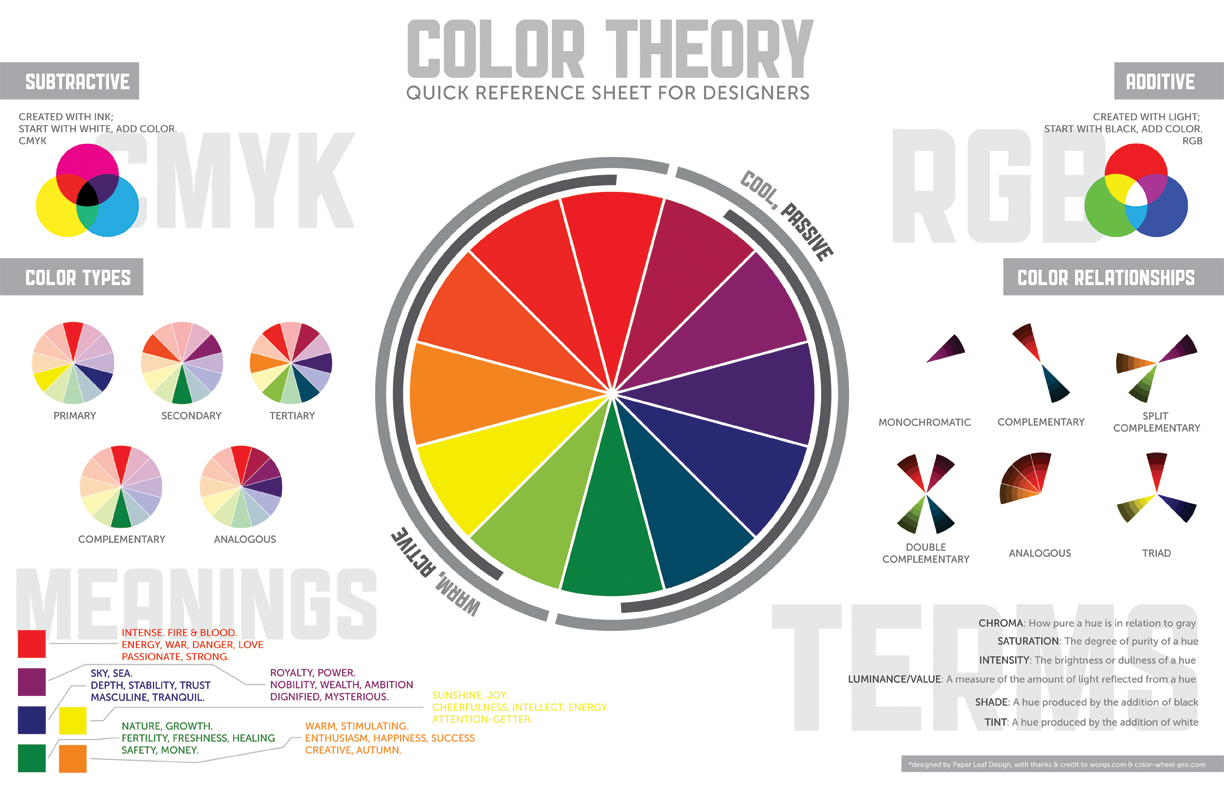
Color theory quick reference sheet – www.icanbecreative.com
In her article, Thurow also stresses the importance of cultural color associations, saying: “the color red communicates happiness in China; anger and danger in Japan; and life and creativity in India.” Designing websites for maximum conversions means knowing who your audience is and designing for that audience. For example, a website for a naturopath and massage therapist likely won’t want to use reds, but will opt for blue instead because of it’s calm, relaxation-based connotations.
A color scheme that works for one website may not work for another, and deciding on a color scheme can be one of the toughest decisions for a designer to make. So how does a good web designer determine the color scheme for a website? Complementation, Contrast, and Vibrancy should be some of the deciding factors in your color scheme.
The vibrancy of the color on your website has a direct affect on the “emotion” behind your design. Brighter colors seem more energetic, which will help invoke an emotional response, whereas darker shades are relaxing, letting the user focus on the content.
Contrast between elements in your web design help drive the focus of your site – drawing attention to certain page elements. You can clearly divide elements on the page to direct the viewer’s eye to certain text, links, or content by just using contrast.
Complementation is a way of building relationships between colors. Considering complementation in your web design, you may want to use split complementary colors (colors across from each other on the color wheel), analagous or monochromatic colors (colors next to each other, or shades of a base color), or a triadic color scheme (using 3 colors on separate ends of the color spectrum – like red, yellow, and blue).
With all this information in mind, how do YOU design web color schemes for SEO and maximum conversion rates?
Create an Eye-Catching Site with Innovative Web Design
Posted by Rory Martin in Web Design and Development on August 15, 2012
At RoryMartin.com, we put a lot of time and effort into web design and development, because we recognize the importance of the website as your introduction to the world. With people using the web for everything nowadays – research, communication, shopping, networking – a website must work hard to attract and keep an audience.
The perfect website should be unique, yet recognizable
This means that the site should be different enough from its competitors to be memorable and exciting, but that traditional features which appear on many sites should be in obvious and expected places. Have you noticed that Login buttons on social media sites are almost always in the top right? People will naturally gravitate to that area to log in or sign up to your site, and if it’s not there, they will become frustrated at having to search for it.
The perfect website should be easy to navigate
Web users expect to be able to achieve most things on-line in two or three clicks. If they search ‘Comedy nights’ and your website comes up, but listings aren’t immediately available in two clicks (or less!) they will quickly head somewhere else – and this is bad news for your Bounce Rate. A good website should also be completely navigable from within the site; this means that a user should never have to click their browser’s back button! These are the kinds of issues which usually asrise during the testing process, and are quickly resolved.
The perfect website should be eye-catching, but not overwhelming
When you want your website to stand out, it can be tempting to make the headers even bigger, use lots of different fonts and throw photos at it like confetti. Users who arrive at a site like this quite literally will not know where to look! At RoryMartin.com, we like to keep things slick and simple.
Against this background, a different header font or announcement photo will have a greater impact on audience attention.
The perfect website should be clear about its purpose
Do you design stained glass windows, wash windows, install double-glazing, or sell glass paints? When a web user can reach your site by searching very common terms, it pays to have a tagline which makes the purpose of your site clear. This might increase the bounce rate of visitors to the site, but it will also prevent people associating your site (and services) with being a waste of time!
The perfect website should be up-to-date
Most sites will have a copyright notice in their footer. If people are going to trust your site, then this copyright certainly needs to be up-to-date! Another way of appearing up to date is to have a regularly scheduled blog, or social media accounts displayed on the page, which are updated every day, or near enough. This immediately lets people know that someone is on the other end of this website, and that it’s easy to get in touch with them.
At RoryMartin.com, we put a lot of time and energy into web design and development, in order to build amazing sites that mirror your business strategy. Talk to one of our Seattle web design experts today about what we can do for you.
Pinterest Influences Web Design Trends
Posted by Rory Martin in Web Design and Development on March 15, 2012
Pinterest is big in the social media marketing sphere (Haven’t heard of it? Click here to read about how businesses can use Pinterest), and it’s making waves in web design as well. The unique layout Pinterest offers is becoming incredibly popular with businesses who are looking to reinvent themselves online. In fact, some magazines from publishing giant, Condé Nast, are launching new designs using a grid-style layout, with minimal text and tons of pictures. Not only are publishing houses looking at this new style, Flickr – the popular photo-sharing website – is set to upgrade and redesign it’s site within the month, to make it look more like Pinterest.
The success of this type of layout could be because Pinterest users say they need to create and curate, organize and compartmentalize ideas in an increasingly scattered digital world.
Companies are working to create sites that feel more like brand lifestyles than sales pitches and corporate information. Mashable’s Community manager, Meghan Peters says that Pinterest allows users to “experience the web in a way that makes them feel productive and inspired”. This is one of the bigger roadblocks to creating an engaging corporate experience. In fact, Flickr has switched to this design style because, ““We see in our first metrics that people consume a lot more photos, they interact so much more with photos in this view.”
In web design and typeography, Pinterest is also inspiring designers – not through its layout, but through mood boards created by other illustrators, graphic designers, typographers, etc. We’ve been using Jquery plugins that accomplish Pinterest-like layouts for the past couple of years. Our vertical layouts emulate the forward thinking of Pinterests vertical layouts.
What we do at RoryMartin.com is remain technology agnostic. Since we use the latest and greatest technology from the vast world of open source developers we can stay ahead of the times when it comes to making our customers’ users happy.
Pinterest’s success is an example of proving our philosopy; that new information architecture can and should be adopted based on what users tell us they want. In this case – Pinterest users spoke up – and we will continue to listen.
Engagement Focused: Sevenly.org
Posted by Rory Martin in Web Design and Development on March 1, 2012
We’ve heard a lot about the hip new startup, Sevenly, that provides users with an easy and efficient way to make a difference in the global community. What we like about Sevenly is that their web design offers a strong call to action, content that is presented in a way that’s easy for users to digest, and places a focus on how users can give back to their community. Sevenly CEO, Dale Partridge says, “In today’s world, if you aren’t constantly improving your website… you’re falling behind… We listen to our customers and figure out what they want and what would make the process of supporting our causes easier…”
The site makes sure to include an in-depth explanation of what they do and how they donate their funds. They also offer cause statistics, and highlight how Sevenly users have contributed to their charity partners. Sevenly’s users are encouraged to support campaigns by both making donations and promoting the cause through social media. The new site design is committed to building awareness, finding funding, and building a following.
The design is heavy on imagery, light on text and highly graphic for impact. It focuses on numbers, statistics and charts to show each user how they’re helping the community. They also have full Facebook integration, allowing users to comment and share their own stories.
We liked the way the site was focused on user engagement. As businesses start to use Facebook more, we feel it’s important to remember that Facebook should be a social media tool, but it shouldn’t be the ultimate landing page for clients or users looking to find out more about your brand. It’s important to have an engaging corporate page, where users can go to ultimately connect with your business. We give Sevenly’s site an A+.
—
RoryMartin.com is a Seattle Web Design company that specializes in Seattle Search Engine Optimization and Seattle Social Media Marketing. To make an impact with your website visit us at RoryMartin.com.
Build a Better Website with Tips from Rory Martin
Posted by Rory Martin in Web Design and Development on January 5, 2012
Netcraft reported that as of November 2011, there were approximately 525, 998,433 websites out in Internet-land – and many of them aren’t perfect. Think about it: when you look at your website, what do you see? Do you see a sleek design? Is it easy to navigate? Do you see compelling imagery or a big block of text? Are you missing the little things like SEO or a Footer? Are you effectively using Social Media? Or have you forgotten to actively add that element to your website?
To make your website more “perfect”, you need to think about all the things we’ve just mentioned. Seattle Web Design and Social Media Marketing company, RoryMartin.com can help you perfect your website with a few tips on designing a better website.

It’s true that content is key when it comes to making an impact on the web, however design is also key. There are a variety of browsers, processors and monitor sizes, so it’s important to design a site that looks great on all of them. While you may use Firefox or Chrome, and so you may design for those two browsers, consider the fact that 40% of internet users STILL use Internet Explorer. Cross-browser compatibility can be a difficult problem to solve, but producing a sleek design without all the extra bells and whistles can save you some time in trying to determine why this or that widget doesn’t work.
Design also plays a big part in your website’s layout and navigation. Consider this – 60% of the time, users cannot find the information they’re looking for – and much of that is due to poor execution in navigation and UI design. Making sure your site is simple but well-designed could save your visitors a lot of time and effort trying to find out where you’ve hidden that gem of information they’re looking for. And where user interface is concerned, users report clicking away from a page that has pop-ups or plays music or video automatically when the webpage has loaded.
One big part of web design that is often overlooked is the footer. Often, businesses forget all about the SEO properties and usability of their footer in favor of more visible elements like header images and information. At RoryMartin.com, we build footers for clients that include copyright information, the company address and contact info, their business tagline and even quick navigation links for the web-user who’s made it to the bottom of your page. We also recommend links to your social media profiles, because, as users arrive at the bottom of your page and want to know more, the footer can convert your web visitors into Twitter or Facebook followers.
Are you actively using social media? Is it easy to find your social media links (and maybe even your Twitter stream) on your website? Web marketing consultant Chris Brogan says, “Social Media puts the ‘public’ into PR and the ‘market’ into marketing.” Social media is one of the easiest, most direct, and most prominent forms of both public relations and marketing, available to businesses today. If you’re not using social media, and displaying your information prominently, you’re missing out on a huge target audience. And, studies have shown that social media builds customer loyalty.
SEO or Search Engine Optimization is probably the biggest key to driving customers to your site. Using a correct combination of keywords and search terms throughout your website in strategic places will help propel your website to the front page of Google. Of course, being on the second page of Google’s search isn’t bad either – considering a quarter of all web searches progress to the second page of Google. But keywords aren’t the whole story: Though 42% of users click the top ranking link on Google, the text that shows up beneath your link is REALLY the driving factor. It’s this text – copy pulled directly from your website, that truly drives traffic to each site, while your strategic keywords ensure you’re listed in those search results in the first place.
If you’re looking to update your website, grab the wide world of social media marketing by the horns, or just looking to manage brand communications, our skilled staff of social media marketing and web design experts can help. Find out more about what we can do for you at www.rorymartin.com.
Why Should I Customize my Facebook Business Page?
Posted by Rory Martin in Social Media Marketing, Web Design and Development on October 10, 2011
With the popularity of Facebook fan pages and the releases of new timelines, it’s becoming increasingly important for businesses to implement a customized Facebook page for your business. Since the new Facebook Timeline feature shows your posts to your fans and your fans friends, in a ticker at the top right-hand side of the page. Your posts now reach a much wider audience – and you need to stand out from the crowd.
Offering interesting updates with a well-designed Facebook Page is often the deciding factor in whether or not your fans will choose to interact or share your page with their friends. Building interaction with your fans is an important factor – you need to have relevant information that isn’t always self-promotional. However, we like to stress the importance of having a well designed Facebook page, that offers incentives for prospective fans to click “like”.

Do you "like" the RoryMartin.com reveal tab?
Consider this: The first thing users see is your business’s wall – and while that may have relevant information, it may lack the branding your company needs to make an impact. We’re finding that businesses are increasingly aware of the visual impact their Facebook page has, and trends point to the increased use of “splash pages” or reveal tabs for facebook pages. It’s the equivalent of having an active ad built directly into your page that’s clickable. You can set these Facebook reveal tabs to be clickabe so that users can click to like, which would reveal discounts, for example.
When it comes to the internet, looks are everything. The design is as important as the implementation. Having a well-designed landing tab will help you stand out from the crowd. Keep it simple, and neat. Don’t go overboard with apps. Be consistent with your branding, and display different pages for fans and non-fans. You can even engage your current fans to take another action via links or reveal tabs. RoryMartin.com builds these welcome tabs and customizes facebook pages for a variety of clients.
And while you’re customizing your Facebook fanpage, it’s a good idea to consider implementing a custom URL. If you have 25 or more fans, implementing a custom URL on your facebook page will increase your search engine rankings and will be easier to promote. Consider your custom URL another step towards branding your business.
Here are a few simple ideas for implementing customizations on your Facebook Page
- Display the services or products you offer
- Be sure to include a specific call to action, along with a link so your fans can actively participate
- Host a contest
- Make sure to post about your blog, and share your blog posts with fans
- Let people know who you are and what you’re about
- If you do any charity work or special events, make sure to share those
- Give fans a reason to like your page by using reveal tabs, or by letting users know what to look forward to
- For your fans, let them know how they can contribute
- Share your twitter posts
Now, more than ever, it’s increasingly important to make sure your social network business profiles are integrated into your marketing and branding. If you’re not sure how to implement social media into your marketing strategy, come see us at www.rorymartin.com.
Recent Comments