
Posts Tagged social media strategy
Make Your Keywords Pack a Punch
Posted by Rory Martin in Search Engine Optimization on June 28, 2011
Keywords play a large role in search engine optimization, and are a key factor in social media marketing. Having the right combination of keywords will generate hits, increase traffic and drive sales; however, it’s not always easy to determine which keywords are right for you, and where your keywords aren’t packing a punch. At Rory Martin, we specialize in helping business come up with relevant keywords that drive traffic to their site. We do the research so businesses don’t have to.
– Ask yourself: What would my customers search for?
This seems relatively easy enough. If a customer would find your services by searching “freelance writer Los Angeles”, put that on your list. Your keywords might be words your competitors use or words that are industry specific. Think up simple terms and phrases that specifically target your site or business, but know that using one word is going to decrease the likelihood that your site will stand out in a crowd.
You will get higher search engine ranking by choosing a mix of specific longer phrases, and general targeted keywords. Look at the breakdown of search terms as they show up on Google:
|
Number of Google Matches |
Term |
|
11,600,000 |
writer |
|
1,200,000 |
real estate writer |
|
48,000 |
freelance real estate writer |
|
9,000 |
freelance real estate writer los angeles |
Source: WebsiteHelpers.com
You’re going to have an easier time getting click throughs if you narrow it down a little – by adding your location, but be cautious about being too specific. For example using “Neon Helmet Tacoma WA” won’t drive people to your site. Phrases that are just too specific may offer you the #1 slot on Google, but still won’t deliver the clicks you’re looking for, because they’re not keywords that people would search for. Ranking #1 on terms that nobody is searching for is just as bad as ranking #300 for terms that everybody is searching for. You can’t get the traffic if people aren’t using your search terms, no matter how well you’re ranked.
When you have a list of possible keywords, check out tools like Google’s Keyword Tool, that will help you determine whether or not people are actually searching for those keywords, by populating a list of terms related to the keyword you entered. Look for targeted keywords, and specific phrases that are relevant to your business and your industry.
Search Engine Optimization through keyword analysis is one of the most effective ways to increase targeted traffic to your web site. At RoryMartin.com, we put our Seattle Search Engine Optimization experts to work to research your target audience, determine what keywords they are searching on, and then make sure, through proven search engine optimization tactics, that your web site is the one they find.
As a Seattle Web Design company that specializes in Seattle Search Engine Optimization and Seattle Social Media Marketing, RoryMartin.com can help you build a Social Media Strategy that reflects your unique brand and meets your business goals. From a one-time site analysis to full search engine optimization strategy and execution, RoryMartin.com can help match your keywords to your SEO needs.

The World, in Social Networks
Posted by Rory Martin in Social Media Marketing, Social Networking on June 24, 2011
We found a cool infographic from Vincenzo Cosenza’s blog (Vincos.it) showing the world in Social Networks. Vincenzo says,
Facebook is slowing gaining users around the world (almost 700 millions) establishing its leadership in 119 out of 134 countries analyzed (in this edition I’ve added Ethiopia and Tanzania).
Europe has now became the largest continent on Facebook with 205 million users…
It’s interesting to look at how these numbers have changed this year.
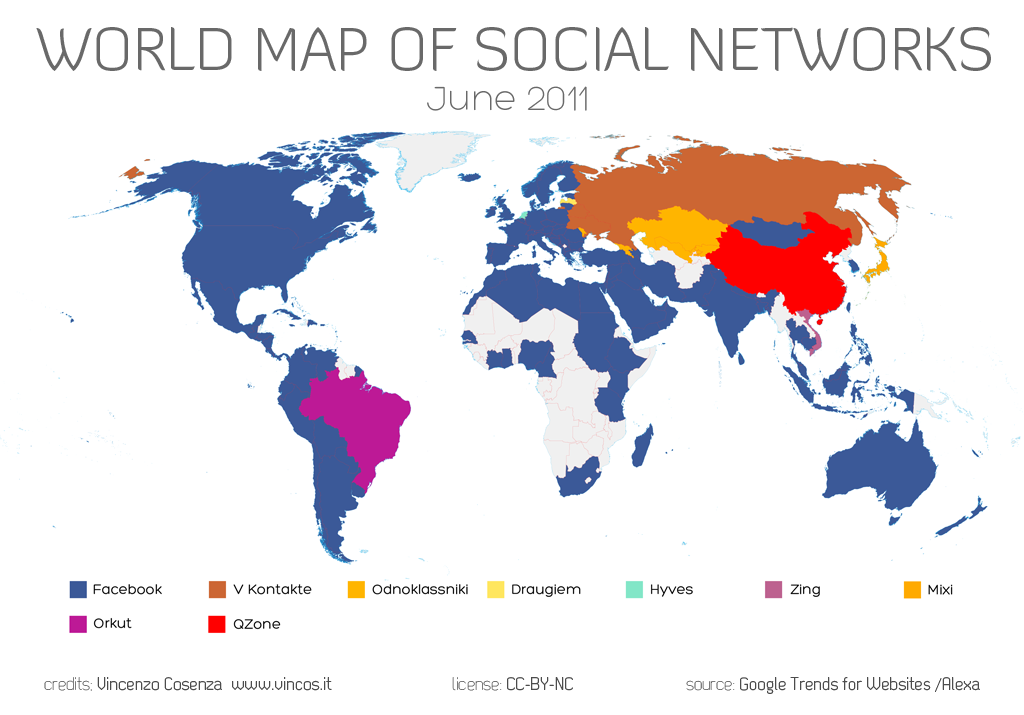
Facebook is by far the social network winner here, so we encourage our clients to make sure they have a solid presence on Facebook and are actively engaging their customers. Need to know what goes into your Facebook strategy? In this article we tell you how to make an impact on Facebook.
RoryMartin.com is that secret weapon that will revolutionize the way you engage with your clients and end-users. We offer a comprehensive set of services from website design and web development to search engine optimization, search engine marketing and social media marketing for companies large and small.
The Periodic Table of SEO
Posted by Rory Martin in Search Engine Optimization on June 10, 2011
We found something cool today – from the folks over at SearchEngineLand, who say:
Search engine optimization — SEO — may seem like alchemy to the uninitiated. But there is a science to it. Search engines reward pages with the right combination of ranking factors, or “signals.” SEO is about ensuring your content generates the right type of signals.
They put together the Periodic Table of SEO to help readers get a visual idea of what goes into producing the right ranking factors that make your website shine. At Rory Martin, we take all the factors into consideration when we’re building a strategy for SEO, online marketing and social media management. Since we often talk about how important SEO and Keywords are to your website’s value, we figured you (our readers) would be interested in this graphic too! (Click the image for a larger view)

As a Seattle Web Design company that specializes in Seattle Search Engine Optimization and Seattle Social Media Marketing, RoryMartin.com is dedicated to helping you find the right tools to optimize your website, and bring you the most exposure to help your business succeed.
Trend Forecast: Social Media’s Immediate Future
Posted by Rory Martin in Social Media Marketing on June 7, 2011

There are big trends happening in Social Media right now, from the use of scanned location check-in points, to social commerce. It can be hard to navigate the trends but we’ve compiled a few of the most common themes into 3 predictions on where social media is headed in second half of 2011.
Social, Mobile Entertainment –
Games have moved onto mobile devices, now that smartphones are relatively inexpensive, prevalent and readily available. Social media is giving users a way to take their entertainment on the go. Now instead of filling out a crossword while commuting, you may use Words With Friends. Or you might make a game out of being in the right place at the right time through Foursquare – ousting your friends, and letting people know where to find you. It’s a way to stay connected with other users while managing a busy lifestyle, from Facebook gaming to sharing last night’s football or Mad Men highlights over Twitter, even watching YouTube videos via an Android application. It’s entertainment to go, and integrating more social technology into your business and website will make it much more appealing to social media users.
Scanning, Scanning, Scanning –
When you’re using check-in services like FourSquare and the Facebook places application, you may be able to scan a barcode or QR code, checking you into your location on relevant social sites. With the emergence of social scanning, it’ll only be a matter of time until you can scan a barcode, which adds a “Like” to the business’s Facebook Page, or pulls up the latest Yelp Reviews and Groupon coupons for the location you’re at. It’s a business strategy – integrating social media and marketing in an easy-to-use way.
Mobile Workplace –
As smartphones become better and faster, we’re seeing users move from laptop to mobile (as desktops have been pushed out of the way for smaller, lighter ways to work-on-the-go). This means websites need to plan for mobile content that will load quickly on a mobile network. Businesses should start looking for ways to accept mobile payment, and will have to consider dynamic pricing to keep up with supply and demand. And since smartphones often double as media storage devices, it won’t be hard to keep your PowerPoint presentations handy for your next business meeting.
These are a few of our predictions for the coming year – companies will want to work these trends into their social media marketing strategy. At RoryMartin.com we do the research on tips, tricks and tools of the trade when it comes to SEO, online marketing and social media management. As a Seattle Web Design company that specializes in Seattle Search Engine Optimization and Seattle Social Media Marketing, RoryMartin.com can help you build a Social Media Strategy that reflects your unique brand and meets your business goals.
Tips to a Stellar Social Media Strategy
Posted by Rory Martin in Social Media Marketing, Social Networking on May 20, 2011
As social media becomes a key component in online marketing, businesses who aren’t creating and implementing stellar strategy may be left in the dark. Social media creates buzz around your business; and as your company becomes more visible, social media drives traffic to your business or website. With a solid strategy, you’ll have a chance to talk to new and interested audiences, while ultimately becoming more user-friendly. We’ve curated a few key tips to make your social media plan succeed:
Listen: Social media is a communicative tool. As with any form of communication the best thing you can do is listen. Listen to your audience, your competitors, and people you want to work with. Listen, or look for conversations that you want to be a part of. Listen to, and watch social media influencers and keep track of ways that you can contribute to become an authority. There are tools that you can use to monitor these conversations, and track keywords, once you determine which users and conversations are relevant to your business. But above all things it’s best to determine who your target audience is, and why they want to be a part of your sphere.
Once you have a clear line of sight it’s time to…
Plan: Social media influence *can* happen organically, but for a business it’s best to take the bull by the horns. Listening to the buzz happening in the social media world will help your business determine your social media goals and objectives (these should tie in to your businesses goals and objectives). Plot out which social media sites you’d like to use and the contacts you’d like to gain. Define your strategy, the people who will implement that strategy, and how they/you will engage with your audience. Plan out the time it will take to implement this strategy, so you don’t waste time splashing around in the metaphorical social media pool. Create a social media calendar that coincides with that strategy, so you’ll know what kind of content to create and when. As Margaret Thatcher once said, “Plan your work for today and every day, then work your plan.”
And while you’re doing all this planning, remember that the best connections are personal, human connections so you’ll need to…
Engage: Be a part of the conversation – the HUMAN conversation. Creating relationships in the social media world is important to creating trust between your brand and the world. Develop a deeply human relationship with your audience, and your audience will reward that relationship. Show them that your business is a team of actual, relatable people, not just a big logo run by a bunch of robots. For example, a set of auto-tweets won’t be nearly as effective as coming up with relevant content that varies from day to day. That’s not to say your auto tweets aren’t important, but that you should also respond to the influencers, audience and industry relevant to your business. If it’s relevant to both your contacts and to your businesses goals, it’s a conversation your business needs to be a part of.
And if all else fails, you can check back to RoryMartin.com where we’ll continue to write about tips, tricks and tools of the trade when it comes to SEO, online marketing and social media management. As a Seattle Web Design company that specializes in Seattle Search Engine Optimization and Seattle Social Media Marketing, RoryMartin.com can help you build a Social Media Strategy that reflects your unique brand and meets your business goals
Social Media Marketing – The Value of Business Blogging
Posted by Rory Martin in Search Engine Optimization, Social Media Marketing on April 29, 2011
There is a common misconception among business owners as to the value of business blogging. Many believe that they do not have time to effectively implement a Social Media Marketing campaign or that there is little return on investment. RoryMartin.com a Seattle Web Design company that specializes in Seattle Search Engine Optimization and Seattle Social Media Marketing can help you build a marketing strategy that reflects your unique brand and meets your business goals.
A corporate blog is a marketing asset and therefore, an asset to your business. Properly executed, a blog will continue to drive traffic and leads to your business over time and should be viewed just like Search Engine Optimization, a due diligence process that is not a short term experiment, but a long term investment.
There are many reasons to consider a business blog. By delivering fresh, compelling, keyword-rich, original content you will bring users back to your site on a regular basis, helping increase awareness for your brand and driving your site up in ranking. In addition to gaining search engine ranking and generating leads, blogs engage your current customers and place you in a position to provide thought leadership to your industry, strengthening your brand.
Optimizing a blog that engages customers and prospects while furthering your company’s mission and business objectives, is much like optimizing a website. By implementing search engine optimization, your blog can rank much higher than static website pages in the search engine results. Over time, this drives up the ranking of your company website.
In order to measure Social Media ROI you must define clear measurable goals. RoryMartin.com’s online marketing campaigns deliver both measurable revenue as well as ancillary brand building benefits for your company. It is important to understand the value of a visitor. Each visitor becomes one of three things; a browser, an influencer or a transacting customer. A transacting customer delivers immediate financial impact which can be measured as ROI. Browsers and influencers are measured as ancillary even though they directly affect your financial bottom line, just not in the immediate sense. Their value falls into the category of non-actualized potential.
Some of the most substantial benefits of a social media campaign will be difficult to measure directly. There is no concrete financial value that can be assigned to reputation management, branding and customer service. However, every business owners knows those values are indispensable.
Five Leading Contributors to Facebook Fan Value
Posted by Rory Martin in Social Media Marketing on April 25, 2011
As growing audiences migrate to social networks like Facebook, a brand’s ability to connect and influence these customers must shift from traditional marketing strategies.
Facebook offers a great platform for developing stronger relationships with your customers. Facebook fans represent a significant opportunity to drive revenue enhancement, brand, and loyalty without incurring the considerable cost-per-person of conventional marketing.
The five leading contributors to Facebook fan value are:
- Product Spending
- Brand Loyalty
- Propensity to Recommend
- Brand Affinity
- Earned Media Value
How you interact with your Facebook fans is more important than the number of non-engaged fans your page has. So the question is how to manage this platform to build loyalty and generate sales? Fans are an extremely valuable segment of the Internet audience and should be addressed with specific strategies to nurture their ongoing participation and influence. RoryMartin.com offers comprehensive Social Media Marketing services to help your company tap into the power of social media.
Facebook Strategies Allow for a Discernible ROI That is Not Allowed by Most Other Approaches.
- More than 10 million users become fans of pages each day.
- On average fans spend an additional $71 on products for which they are fans compared to those who are not fans.
- Fans are 28% more likely than non-fans to continue using the brand.
- Fans are also 41% more likely to recommend a fanned product to their friends.
RoryMartin.com helps clients educate their markets and build brand awareness while winning and retaining customers with engaging and impactful websites and web marketing. As a Seattle Web Design company that specializes in Seattle Search Engine Optimization and Seattle Social Media Marketing, RoryMartin.com can help you build a Social Media Strategy that reflects your unique brand and meets your business goals.
Social Media Monitoring : Radian6 vs. ScoutLabs
Posted by Rory Martin in Social Networking on September 22, 2010
Ever since I reported on the launch of Scout Labs, I have had people ask, fairly or not, how it compares with Radian6. It’s no secret that I use Radian6 at Doe-Anderson, am good friends with many of their employees and have recommended them to people left and right for a long time. Scout Labs appeared on the scene in February after two years of testing and development and they have a very nice social media monitoring tool.
To be completely fair, it should be noted that the two companies have slightly different target audiences, strengths, technologies and approaches. Scout Labs is a self-serve, web-based tool priced for small to mid-sized business and brands. Radian6 was originally positioned as an agency model where a single ad agency that worked with many brands could economically offer social media monitoring to its clients. It quickly moved on the market thirst for social media monitoring and expanded their approach beyond ad agencies and PR firms, but they are probably best suited for medium to large sized brands and businesses.
Still, if there is something to be had with Scout Labs for a better price, we ought to know what it is.
So, while setting up and monitoring mentions of a Louisville-area heath care system recently, I composed this comparison on setup, features and price. I chose the health care system because they have several different locations, thus potential keywords to search for, but weren’t a typical “national” brand so the volume would be manageable. Here’s what I found:
Radian6 offers a very simple setup. You start a “Topic” and add keywords. For billing purposes, you’re billed for each “Topic” so all of your searches need to come under that topic set up or you’ll pay more. I added several different keywords based on the name of the health care system and one of their locations. After testing the results returned, I quickly had to add some omission filters for a popular actor who has apparently appeared in several movies about hospitals and shares a name with the brand in question.
Still, the whole set up took 10 minutes. I’ve used Radian6 for a while, so it was familiar territory, but it is fairly easy to understand and navigate once you’ve had the tour from a Radian6 rep. (I wouldn’t say it’s particularly intuitive if you’ve never been in it, but it’s not hard to grasp.)
Just minutes later, I had a “River of News” that revealed 54 posts from the world wide web related to the health care system. You can sort that river in a number of ways to prioritize how you respond or weight the posts. A few clicks later, I had a topic cloud of popular words from those posts. With a few minutes of set up, I had some charts and graphs of some keywords I compared to see the volume of posts related to thinks like, “long wait time,” “terrible service” and “great service.” In Radian6, you can essentially compare any number of topics or keywords against one another, pulling frequency data from your river of news. You can also pull topic clouds or segment that division of data … they really allow you to slice the data any number of ways. Again, you need a little training to know how — even though all you do is click on the word or the bar graph to dive into it, you don’t get that from just looking at it — but once you do, you can slice more than a Benihana’s chef on speed.
Radian6 also produces an influencer report which gives you the most influential authors or sources from your river of news. This is good information to have, though the data is skewed a bit by the limits of your time frame (mine was set for the last 30 days). Still, I love the way Radian6 has added individual Twitter users as “influencers” on the chart. That is much more relevant to the live conversation of the day than which blog mentions the brand more.
Something new Radian6 has added to their River of News view that turns their tool into a much more actionable platform for brands and marketers is the Workflow view. You organize your River of News into a work space that allows you to mark posts for follow up, assign that follow up to team members and make the results actually work for you. Yes, this is a manual function, but one your company will want to use and participate in because it allows you to use your monitoring to realize results and proactively engage those voices talking about your brand.

Radian6 Workflow view with actionable step links to the left.
This particular interface and function of Radian6′s tool would take me a complete second post to tell you about all the features and strengths. There’s tie-in with Google’s social graph API, automated alerts for subjects (giving you Google Alerts on steroids), tagging and activity logging of contact with specific bloggers, a completely mind-boggling integration with Twitter to manage communications with an influencer on that particular network. Oh, and you can have all your “River” results pumped to you via instant messenger so you are never out of touch with what’s being said about your brand.
Frankly, this dashboard functionality blows all other competitors in the social media monitoring space out of the water. If you’re paying hundreds of thousands of dollars for the big boys, you’ve lost your mind. This alone beats them, hands down. (Unless, of course, you just have to have the 56 page PowerPoint with mindless pie charts no one reads.) For medium to small brands, however, it’s overwhelming and impossible to manage or use all the functionality without spending hours a day using Radian6 (which is, I’m sure, what they’re hoping for). The reason I say that, however, is that there’s normally just one or two people managing all this for smaller brands and that isn’t their only role. This is a tool best used by teams of communications staffers.
Oh, and the ability to slice and dice the data in Radian6 is just sick. Once you know how to do it, you’ll swear by this tool.
The only bad thing about my Radian6 experience is that it crashes my browser in Firefox. Maybe it’s too powerful. It works fine in Safari, so I just use it there.
That said, the Radian6 scorecard of results showed 54 total items found, including 17 posts from Twitter, two videos and four images.
In Scout Labs, I set up a “Search” much like the “Topic” in Radian6. The keyword or exact phrase setup was a little disappointing until I got them on the phone and asked about it. They were nice to (politely) point out there’s a big “Click here for help” button that I missed. What can I say? I don’t read instructions.
In order to play out the clumsy usage like the average person would, I used the brand name, then the word “Healthcare” and the name of one of the brand’s locations as qualifiers. (“Relevant” in Scout Labs terms.) Unfortunately, that set up yielded over 10,000 posts. Even adding all sorts of qualifiers (the actor’s name as an omission, etc.), I could only get it down to 8,500 posts. So, I set up one search for, “Brand Healthcare” and “Brand Location” where the brand and location are obviously specific to this particular organization. There was no real way to mash those results up (keeping in mind I didn’t read the instructions on how to do so), so I did that manually for comparison sake.
Once that was done, the information produced included 72 total items found, including 23 posts from Twitter, 22 videos and 18 pictures. For the record, I ran it the way I should have (having read the instructions) and the numbers and content were all but identical.

A sentiment trend view from Scout Labs.
Once you’ve set up your search in Scout Labs, within seconds and a couple of clicks you have charts and graphs for volume of articles, share of voice compared to competitors you may set up to track as well and the kicker – automated sentiment so you know if the talk about you is good, bad or neutral. Since this is manually scored in Radian6, you just saved yourself a fair bit of time to produce a sentiment report, though it requires that you trust the automation. (I highly recommend manually checking any sentiment score from any service until you’re confident they’re accurate or you can at least live with the ratio of right to not-so.)
Scout Labs also separates results out by medium, giving you a tab to see posts or conversations and separate tabs for photos, videos and Twitter. With Radian6, they’re all together in your stream, though easy to delineate. You can delete or remove posts you don’t want considered very easily using both tools. Instead of a topic cloud, Scout Labs lists popular words discovered in your stream and goes the added step of indicating which words are new in the last 30 days. This gives you a quick and automated glance at what topic might be trending or a sore spot that consumers are complaining about.
Comparing the results, it’s clear that Radian6 has a much more thorough scan of the web. News items posted on WFPL.org, the website for the local NPR affiliate, were not picked up by Scout Labs, showing some apparent holes in their scans. They also don’t do a good job of catching message boards and forums, though I’m sure that will improve over time. Radian6 didn’t do that well with forums a year or so ago when I first saw their platform. They’re better now.
Of the nine posts returned by Scout Labs, Radian6 only had three of them, and while the tool should have found them, I would only consider one of the six relevant to the search as three were job postings and the other two appeared to be spam sites. While I’m not sure why there was an inconsistency in the number of Twitter messages returned, it may have something to do with spam/duplication filters. The entries Radian6 failed to return appeared to be re-tweets or exact duplications of bot-controlled feeds.
Scout Labs did out-perform Radian6 by returning lots more videos and images. There was a Flickr set of 17 images I found through Scout Labs of a newborn baby that wasn’t in the Radian6 filter, all tagged with the hospital’s name. However, none of the four images Radian6 returned, all of which were relevant, were to be found in the Scout Labs data.
Tit-for-tat comparison’s are relevant but not altogether conclusive, however. The thing that often sets the tools apart is the ease of use and quality/quantity of data returned. Scout Labs offers a more seamless experience in a web-based environment while Radian6 is a Flash interface. It can be clunky and slow, though it is noticeably faster now than in months past. Radian6 allows you to produce topic-related comparisons easier than Scout Labs, in my experience. And, as I’ve indicated, the Workflow tool in Radian6 is simply unmatched in anything out there. It alone is worth the cost of the service.
And while Radian6 has the powerful play of the Influencer Report, which now includes Twitter users in its consideration set (a far better insight than just blogs that mention the brand most often), Scout Labs counters with the trump card of automated sentiment scoring. It is currently time consuming to manually grade sentiment in Radian6. Even though the brand in question only returned 54 posts, it would have taken about an hour to go through each one, read, score sentiment and so-on. In Scout Labs, if I trust their tool, it’s done.
For the record, according to my friends at Radian6, automatic sentiment scoring is coming and soon. Until it does though, Scout Labs has that as a selling point.
While I’m not well-schooled in the back-end technology lingo, Scout Labs uses indexing which, as I understand it, is more nimble and flexible than database-driven information. Radian6 uses a combination of indexing and database technology. Is that a sticking point for them in the long, run? I don’t know and would love some technologists and engineers to chime in. Seems like both companies have good engines and continually improve what they have, so both can give each other good runs for the money for a while. I promise to do more research here to edu-ma-kate us on the differences.
So from a power perspective, I give the edge to Radian6. Both the Workflow panel and their breadth of data collection sets them apart. Scout Labs can probably catch them on the data collection pretty quickly but duplicating their Workflow panel will be tough to do knowing Radian6 is always improving their own tool as well.
From a data perspective, Radian6 also stands out because of their breadth of data, the Influencer report and the data slicing and dicing ease of their tool. (Did I tell you it’s just sick? Sick!) Still, it’s a close call because of Scout Lab’s automated sentiment scoring, which is a big time-saver and important when you consider the good vs. bad is sometimes all a brand manager or CEO wants to hear.
But when you look at price, Scout Labs wins. They don’t limit the number of users \and offer monthly plans starting at $99 (enough to handle a single brand or small business with monitoring of 3-4 competitors). For $249 monthly, you get more searches for competitors or divisions of your business. This would be the price point for the health care system I used. The most you’ll pay for Scout Labs, unless you have a large, customized solution, is $749.00 monthly. That’s almost the entry point for Radian6, which is a volume-based plan with 10,000 “posts” as the lowest price point at around $600.00 per month. And you’ll need to be very meticulous about defining your keyword. If I hadn’t eliminated the actor’s name from Radian6′s scan, I would have been automatically bounced up to the more expensive plans at the end of the month. (Though I can attest, Radian6′s folks will notice inconsistencies and call you to make sure you’re aware you have exceeded your post limit.)
So you get a better price with Scout Labs, but not as thorough a search. Radian6 has what is essentially internal project management software for response management, but Scout Labs offers automated sentiment.
And both firms have a strong footing in customer service and innovating based on their technologies. So both will evolve and get even better at what they’re doing. Radian6 today is far better and vastly different than they were a year ago. Scout Labs is going to trump even themselves in a month or so with new features and broader reach with their searches.
In the end, the decision is going to be unique to each organization or business, so it’s up to you to decide.
If you’re a small business or on a tight budget, Scout Labs is well worth the investment. If you have a little bit more money to spend and want to see a more powerful tool put to use for your brand, Radian6 might be a better fit. But both are infinitely useful and worth the time and money. And both will get better.
As a matter of point and disclosure, allow me to say that I have the utmost confidence in both of these services. I’ve paid a personal visit to Radian6 and am good friends with many of their employees, including CEO Marcel Lebrun. In my brief time getting to know Scout Labs CEO Jenny Zeszut and product VP Margaret Francis, it’s clear they know what they’re doing and are offering a valuable service at a very competitive price point.
Now it’s your turn. If you use one, the other or both, please fill us in on your experience. What do you like? Dislike? What could either do better? They’re monitoring firms, so you can bet they’ll be anxiously awaiting your feedback. Scout Labs is new, but they have a 30 day free trial. Go sign up and let us know what you think. The comments, as always, are yours.
Study Shows Time Pays With Social Media Marketing with RoryMartin.com
Posted by Rory Martin in Social Media Marketing, Social Networking on May 21, 2010
Have you asked this question: Is the time I invest with social media really worth it? Whether you’re new or an old hat with social media, chances are you’ve wondered if the time commitment is really worth the return on investment (ROI).
Make no mistake about it: a true investment of time and resources is necessary to see significant social media marketing success.
But the real question is, “Just HOW MUCH time is needed to see solid success?”
This question was recently answered in the new study, 2010 Social Media Marketing Industry Report, authored by Michael Stelzner. Based on the report findings, ROI is top of mind for most marketers using social media.
Top Social Media Questions Marketers Want Answered
According to the data, the number-one question marketers most want answered is how to track social media ROI. A sampling of questions includes:
- How can I tell a convincing story to management about the ROI for social media marketing?
- What are the key metrics to follow for measuring ROI in terms of customer satisfaction, revenues and brand loyalty?
- How effective is social media versus the resources needed to maintain the effort?
- Are there any industry benchmarks that track the impact of social media marketing?
In the 2009 study, the number-one question from marketers was related to social media tactics, followed by ROI. Now tactics have moved down considerably and the ROI question has moved up. One reason for this could be that social media is maturing and more people have started using the tools and tactics. Now they want to know if the long-term payoff for their time and resources is really there.
Time Versus Return for Social Media Marketing
When looking at ROI, you also have to look closely at just how much time you’re investing. Unlike some other traditional forms of marketing, when it comes to social media, your investment is more time than money.
The industry report results shed some light on the amount of time marketers are really spending on social media marketing.
Out of the 1900 marketers’ responses, almost all were using social media for marketing purposes and the majority of these marketers were fairly new in the social media area.
- 91% of respondents indicated they were employing social media for marketing purposes.
- 65% of marketers have either just started or have been using social media for only a few months.
When drilling down to the actual hours spent using social media tools, the largest group was in the 1 to 5 hours per week range. Of that group, 43% are spending 4 to 5 hours each week on social media activities. A significant 56% of marketers are using social media for 6 hours or more each week and 30% for 11 or more hours weekly. It’s interesting to note that 12.5% of marketers spend more than 20 hours each week on social media.
This chart shows the overall breakdown of marketers’ time spent using social sites.

But even more interesting than the time spent on social media marketing, the report also showed a correlation between the amount of user experience and the time spent using social media tools. The median weekly time commitment for beginners was 1 hour versus 10 hours for those doing this for a few months or longer. Because 65% of respondents indicated they were newbies or just a few months in, much of their time spent on social sites could be more trial and error than solid strategy. Perhaps the difference in time spent using social tools is because the marketers who have the most experience also have more well-defined social media strategies, allowing them a clear plan of action on the social sites.
Just like with anything else, experience is golden. The more user experience one has with social media marketing, the more valuable every minute spent on social media sites becomes. The time spent on social sites is not as important as the actual results. What we really should be looking at is what kind of results are you getting for that 1 hour, 4 hours, even 12 hours per week?
Top Benefits of Social Media
When the respondents were asked about the benefits they’ve received from social media marketing, there were some clear winners that stood out above the rest. When looking at ROI on social media marketing, money in the bank can’t be your only indicator of success. Increased traffic, lead generation and happy, connected customers all are factors in deciding which social media strategies are working best for your business.
According to the survey, the number-one benefit of social media marketing is greater exposure (85%). Improving traffic and building new partnerships followed next. More than half of marketers indicated a rise in search engine rankings was a benefit of social media marketing. The report states, “As search engine rankings improve, so will business exposure, lead generation efforts and a reduction in overall marketing expenses. More than half of marketers found social media generated qualified leads.”
This chart shows how respondents viewed the benefits of social media marketing.

Outsourcing Social Media
Because time and ROI are such a central focus for many marketers, it was surprising to see that very few were outsourcing their social media efforts. According to the report, some factors may be that social media outsourcing is fairly new and the majority of respondents were new to social media, perhaps yet unaware of what they should and should not be outsourcing.
The chart below shows how the majority of marketers are not outsourcing their social media activity.

Where we’re seeing the outsourcing trend is in the larger organizations. According to the report, “the larger the organization, the more likely outsourcing is taking place. For example, 25.7% of large businesses and 25% of mid-sized businesses are currently outsourcing, compared to only 10.6% of sole proprietors.” Like many marketing trends, what starts with the “big guys” tends to make its way to the smaller businesses—therefore, we may be seeing more outsourcing overall in the coming year.
Check out the full report here.
Now it’s your turn! Do you feel your time using social media marketing is worth the return? Does your own experience match up with the results? Share here—we want to hear from you!
For Social’s Sake: Managing A Brand With Socialized Communications
Posted by Rory Martin in Social Media Marketing, Social Networking on May 5, 2010
Don’t let your brand be a social outcast. Especially in Seattle, NY, LA, and Portland

It used to be that brands sought partnerships with publications to publicize their offerings, host events or write about their products. And many publications did and still do an excellent job at providing these services to help promote a company’s products to specialized audiences. However, the dynamics of buying and selling has shifted the power from the media over to the brand and consumer.
Now, in order to launch a new product, a brand needs to extend its identity in many more channels and to many more audiences. Thus in addition to promoting itself in worthy publications, a brand must have a strategic digital marketing strategy, a solid list of target–and often splintered–consumers, and a multitude of social networks to engage them. Many marketing activities are now direct-to-consumer instead of company-to-consumer. In fact, new research predicts that spending on Internet-based marketing is expected to overtake print ad budgets in 2010 for the first time. For these reasons, traditional media is now adapting to this new marketing reality.
Today’s savvy consumers will respond to a brand that speaks to a need they have identified, resonates with them on an emotional level, or solves a problem that they maybe didn’t even know existed. Brands today are actively harnessing social media platforms to create content and communities to find their brand loyalists or advocates. Once identified and engaged with, brand advocates do the marketing campaigns for them. These brand advocates might enter an online contest to help name a new product or create a new food flavor that then gets produced and distributed. They may select music they want to appear in a videogame. And they can decide to tell all of their friends and networks about how they have taken control of their brand relationships in this new marketing paradigm.
The new model of targeting brand ambassadors is about two-way, open, social engagement and not just top-down and inside-out pushing of products. It is as much from the outside in–from consumers back to the brand. While most brands are implementing social communications programs using one or two social platforms, only a handful are thinking holistically about managing communications across all media and touch points. The requirements are now to communicate who you are as a brand and what you stand for through social media in a far more consistent, strategic and global way. After all, unlike traditional media, online content and experiences are inherently open and accessible everywhere around the world.
RoryMartin.com helps clients educate their markets and build brand awareness while winning and retaining customers with engaging and impactful websites and web marketing. We offer a comprehensive set of services from website design and web development to search engine optimization and search engine marketing and social media marketing.
Recent Comments