
Posts Tagged business marketing
Forbes: 10 Social Media Mistakes
Posted by Rory Martin in Social Media Marketing, Social Networking on August 5, 2011
We found an article on Forbes this morning listing 10 social media mistakes businesses commonly make. They range from not addressing negative feedback, to skimping on social media time, to not measuring your return on investment. Forbes tells you what to do, and at RoryMartin.com, we tell you how to do it:
Mistake No. 1: Not Having a Plan
Sit down with your marketing guru and map out where you want to be with your social media campaign and what you want it to do for you. Be realistic about what you can achieve in 1 month, 3 months, 6 months, 1 year, 3 years. Figure out how you’re going to do it and who’s going to administrate your accounts. Map out your monthly social media calendar and estimate how much time you need to spend on each piece of the puzzle. Great planning produces great results.
At RoryMartin, we create customized social media calendars for each of our clients, making sure we match our marketing recommendations with your marketing plan.
Mistake No. 2: Too Much Too Soon
You don’t have to do everything all at once. Your plan (above) should work in waves. That way, you have ample time to put into each step of your plan and nothing is missed. If you follow your social media calendar you should avoid that overwhelmed feeling of trying to do it all. Keep it simple, and only build when you’re ready to take on a new challenge.
If you don’t have the time to keep up with your social media accounts, consider hiring a company like RoryMartin.com, a search engine optimization, web design and web development, social networking, and social media marketing firm.
Mistake No. 3: Not Measuring Your Success and Return on Investment
You need to know if what you’re doing is producing results, right? Get Google Analytics and become familiar with that tool. Check out Google Webmaster tools (and yes, the two are very different). Create Google alerts, email alerts and Twitter alerts to find out when, where and how your company is being talked about. Analyze which avenues work the best and build on them, which will help you cut out the unnecessary steps in your social media plan.
RoryMartin.com specializes in helping businesses create social media strategies with the analytics and reports that help you see the effects of a good social media strategy.
Mistake No. 4: Underutilizing Social Platforms for Branding
Make sure you fill out every available field you can on those social media accounts. It’s like talking about your company or touting your elevator pitch. The more complete your profiles are, the more accessible your business becomes and the more transparency and brand value those sites have. Won an award? Manta asks for those kind of stats, and that can be the reference your brand needs to pick up that high profile account. Got a blog that offers industry insights? Put that into your LinkedIn profile, to make sure other professionals in your industry know about your blog and have the chance to stay up to date. Make sure your Twitter account is linked to that blog, and to your LinkedIn, and to your Facebook. Leave no stone unturned.
Mistake No. 5: Promoting Without Listening or Engaging
We’ve talked about social media engagement, here on the RoryMartin blog. Social media is a communicative tool. As with any form of communication the best thing you can do is listen. Listen to your audience, your competitors, and people you want to work with. Listen, or look for conversations that you want to be a part of. Listen to, and watch social media influencers and keep track of ways that you can contribute to become an authority.
Be a part of the conversation – the HUMAN conversation. Creating relationships in the social media world is important to creating trust between your brand and the world. Develop a deeply human relationship with your audience, and your audience will reward that relationship.
Figure out why your customers would want to befriend you in their social media networks. They want to know “what’s in it for me?” And you need to be able to answer that question. At RoryMartin.com, we can help you answer these questions and show you how to engage your social media customers.
Mistake No. 6: Not Addressing Negative Comments or Feedback
Instead of responding with ire, or just ignoring this conversation completely, ask those negative commenters what you can do to “make better”. Customer service is all about finding better ways to communicate and better serve your customers. Look at those avenues of social media as creative ways to give better customer service. Start a dialogue with your unhappy customers, and they’ll be a lot less unhappy.
Mistake No. 7: Not Claiming Existing Profiles
Your business is most likely listed in several places you didn’t know about. And the info on those sites may be old, outdated, incorrect or incomplete. The strategy here is to search for your company, across the web, to find out where you are listed and what needs to be updated. After you’ve made a list, go through and systematically update your profiles to reflect your website, your address, your contact info and interlink your profiles – adding things like your Twitter account and Facebook page.
Mistake No. 8: Skimping on Time
Let’s face it: Social media is a time investment. It can take months for your social media efforts to pay off, and patience is key. That’s why tip #2 is so important. Don’t bite off more than you can chew, and know that you’re going to have to block out chunks of time to monitor and engage in your social media efforts. If you don’t have the time, hire a professional who knows the ins and outs of social media engagement, or look for a Social Media Marketing company like RoryMartin.com who can help you build and implement your social media strategy – so that you have more time to run your business.
Mistake No. 9: Lacking Passion
If there’s one thing we have here at RoryMartin.com, it’s passion for social media. Without the passion, your social media efforts may fall flat – you know your brand and as a business owner, you more than likely love what you’re doing. Try to channel that into your social media efforts, since social media is an extension of the way you promote what you love. If you just can’t get jazzed about interacting on the social web, consider hiring social media professionals who have the passion and knowledge to be the voice of your brand.
Mistake No. 10: Not Knowing When Social Media Isn’t Right for Your Business
81% of entrepreneurs still don’t take advantage of social sites like Facebook, Twitter and LinkedIn and 40% small and medium-businesses don’t even have a Web site. That said, internet users spend approximately 22% of their Internet time in social media, making social media a priority for any company that wants to be visible. Think about your target market and your audience. Who are they and where do they spend their time. Maybe social media isn’t right for your business, but how will you know unless you try it?
At RoryMartin.com, we’re focused on finding the right social networking and social marketing options that are right for you. We do the work so you don’t have to, bringing social tools to every business, and making social media simple.

Make the Most of Linkedin for Your Business
Posted by Rory Martin in Social Networking on July 28, 2011
As a web design and web development, search engine optimization, search engine marketing and social media marketing firm, we like to keep on top of the trends – and exploring trends on LinkedIn is no exception. We stumbled across this article that boasts 10 LinkedIn Tips for Professionals, that says:
Despite the hype over Twitter and Facebook, Linkedin offers the greatest opportunity for professionals to make connections that lead to business.
We agreed with Ian Brody’s article, especially the following tips
1. Don’t make your profile look like your resumé. Brody says that the number one temptation when setting up a LinkedIn profile is to fill in all those prior job slots, but that’s ineffective where LinkedIn is concerned. The business connections that you’re looking for are going to want to see solution-oriented details. Add the business name and title, leave out things like, “managed four people who perform business-related tasks.” Explain where you went above and beyond the basic job task, improved something, saved money, or where you were excelled and were just plain awesome.
2. Find Connections – Know your Strategy. LinkedIn is social, and there are a lot of professional networks on LinkedIn, where you can flex your knowledge and show off your skills – for example, you might find us in the LikeSocialMedia.com group. Of course, like any social network, it’s best to get a feel for the pulse of the community. Listen, watch and learn; find out what other pros in your industry are doing and saying and be cautious at first about sharing dissent. Like anywhere (or any social network) first impressions are lasting impressions. And Ian Brody notes, “Create a connection strategy to build valuable discussion.”
3. Ian Brody suggests updating your status to remind people what you do, and what you’re currently working on. If you connect with a lot of people, staying current with status messages can do anything from help you connect with someone who’s looking for YOUR expertise to keeping you up to date on news in your field, to helping you and your brand grow in ways that your clientele are looking for.
What do you think readers? Have anything to add to Brody’s tips for LinkedIn?
If you’re curious about how to use LinkedIn for your business, contact RoryMartin.com to find a strategy that fits your social networking needs, as well as the social tools that simplify your social media integration. We offer a comprehensive set of services from website design and web development to search engine optimization and search engine marketing and social media marketing. If you need creative ideas, easy implementation, and a limited investment into your social media campaign, RoryMartin.com has experts available to assess your needs, provide excellent customer service and innovative marketing tactics before you’ve even signed a contract.
The State of LinkedIn
Posted by Rory Martin in Social Media Marketing, Social Networking on July 12, 2011
Have you ever wondered how LinkedIn actually affects your business? Ever asked yourself why LinkedIn is important to your company’s potential? At RoryMartin.com, we’ve been researching ways for businesses to use LinkedIn to build a better social media strategy.

Having your business profile out there on the web WILL help increase your organic search results, so if you’re not optimizing sites like LinkedIn, you’re not fully optimizing your search engine potential. LinkedIn also helps your business look more complete, and is an established tool for reputation management – especially through customer testimonials.
LinkedIn is also a powerful tool to analyze your company and its connections through your employee network. An article on Mashable notes that, “…it will automatically calculate your company’s median age, top schools, and other companies that they are well-connected to.” This can be effective for recruiting job candidates, and networking in your industry. Through LinkedIn you have the ability to post polls, and receive answers, letting your business know what your clients are interested in, and keeping you up to date on industry standards.
If you’re curious about how to use LinkedIn for your business, contact RoryMartin.com to find a strategy that fits your social networking needs, as well as the social tools that simplify your social media integration. We offer a comprehensive set of services from website design and web development to search engine optimization and search engine marketing and social media marketing. If you need creative ideas, easy implementation, and a limited investment into your social media campaign, RoryMartin.com has experts available to assess your needs, provide excellent customer service and innovative marketing tactics before you’ve even signed a contract.
Deciphering your Bounce Rate
Posted by Rory Martin in Search Engine Optimization, Social Media Marketing on July 7, 2011
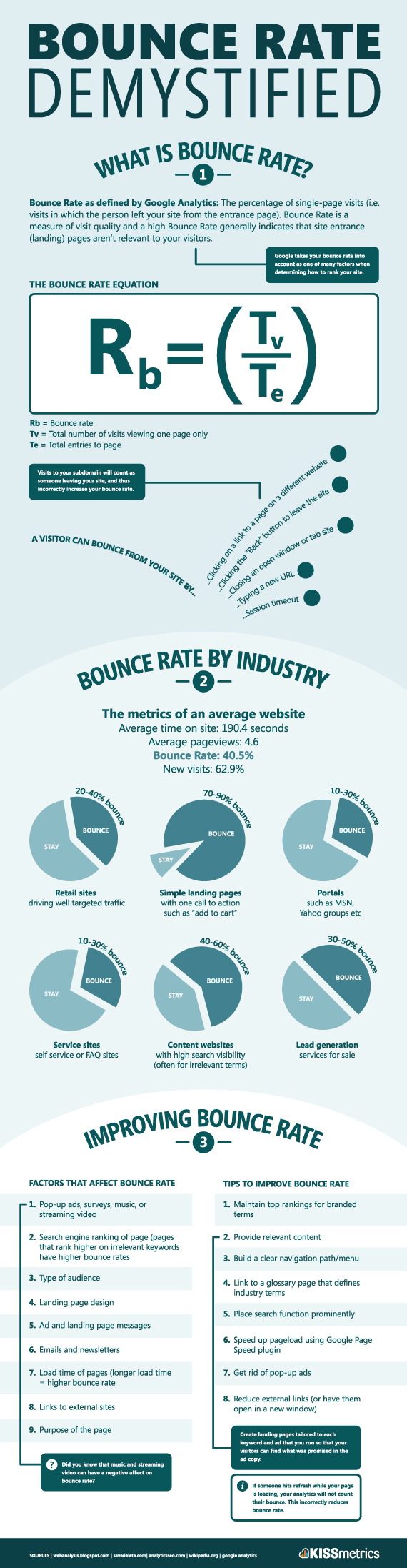
In trying to keep visitors on your site, knowing your bounce rate is half the battle. It can be difficult to determine how your bounce rate is calculated and which factors affect your bounce rate. We found this cool infographic from KissMetrics that shows which factors you can work on to retain visitors, and it even shows the industry standard for your industry. Check it out!
As a Seattle Web Design company that specializes in Seattle Search Engine Optimization and Seattle Social Media Marketing, RoryMartin.com can help you build a Social Media Strategy that reflects your unique brand, draws and keeps visitors on your page. We help implement exciting content and social tools that will make your business stand out. From a one-time site analysis to full search engine optimization strategy and execution, RoryMartin.com can help your business grow.
Time Your Social Media Efforts for Maximum Effect
Posted by Rory Martin in Social Media Marketing, Social Networking on June 30, 2011
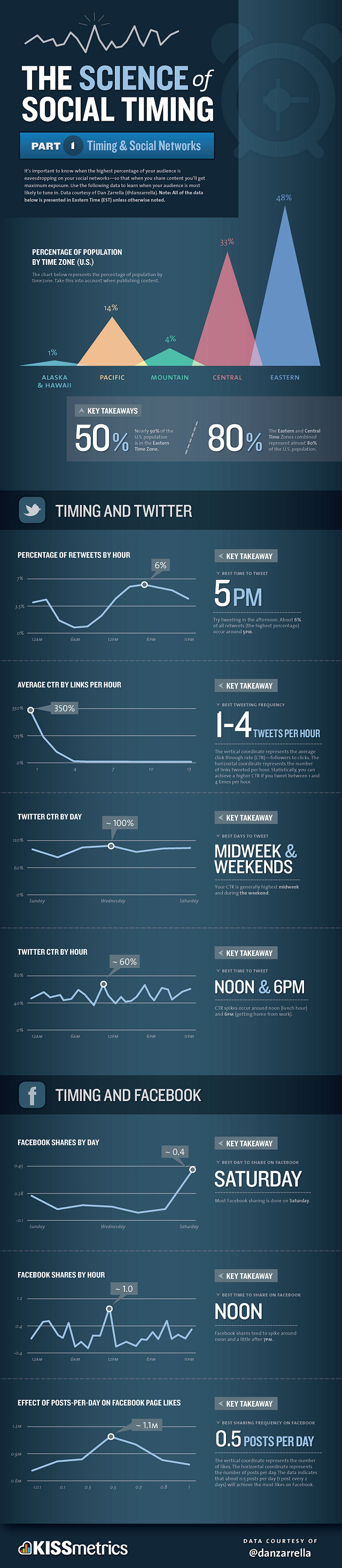
We found a cool infographic on the best times to send out social media posts. We like to couple this with the Problogger strategy for blog postings when we’re considering the best way to send out social media messages. This is a great infographic to keep in mind – especially if you’re using something like HootSuite to schedule your posts. The original post says,
Included are stats for Facebook and Twitter on what days and times are best to maximize the audience size and the possibility that your content will be both found and shared.
As a Seattle Web Design company that specializes in Seattle Search Engine Optimization and Seattle Social Media Marketing, RoryMartin.com can help you build a Social Media Strategy that reflects your unique brand, draws and keeps visitors on your page. We help implement exciting content and social tools that will make your business stand out. From a one-time site analysis to full search engine optimization strategy and execution, RoryMartin.com can help your business grow.
The New Landscape of Social Media Marketing
Posted by Rory Martin in Search Engine Optimization, Social Media Marketing, Social Networking on June 20, 2011
Navigating the new marketing landscape means knowing which marketing tactics are effective, and which tactics are outdated. Improving the visibility of your website has become a marketing priority, yet it can be frustrating since competition for rankings is intense. As many businesses lack the time or cashflow to continuously monitor, report and adjust their strategy, the results of many social media marketing campaigns are often poor. If you’re struggling to boost your page rank, you may need to adapt your SEO and social media strategy to reflect the new trends in social media marketing and search engine optimization.
If you’re not embracing social media as a business, you’re missing out on one of the biggest marketing tools available. Using tools like Facebook and Twitter actually boost your search engine rankings, making your website more visible to search engines like Google. Consider how much content is shared on Facebook each day – users spend approximately 22% of their Internet time in social media, making social media a priority for any company that wants to be visible.
Of course, just hiring an intern may not do the trick. While social media can be a valuable marketing campaign tool, it’s often a commitment. Hiring a professional will ensure that you get the best results from your brand’s digital communications. You want someone who can represent your brand and company, not just the message behind your brand. Social media has become an avenue for customer service, sales inquiries and ongoing questions – you want someone who understands your audience, and can think out of the box in a way that is both specific and familiar to your client base.
Hiring a professional will ensure that your message, and your core product do not get lost in a sea of irrelevant information. Anyone who’s been on the web knows just how much junk the web holds – having a true professional on your team will ensure that your relevant keywords and terms drive traffic to your page. A professional can tell you which information to include and which information is irrelevant. They can help you streamline your content, showing off your product’s benefits in a straightforward way. A social media professional can also help you determine terms that are broad and wide reaching, and help you optimize key words and phrases so that your site gets a good SEO ranking.
Content is still key on the web, and having someone who knows your brand, your clients and your company will ensure that users come to your website because you are an authority. Social media is all about providing something of value to your customers. You need interesting and relevant content, you need high-quality inbound and outbound links. You need customer interaction that is fun and info-rich. Monitoring industry key words and phrases will continually provide feedback on what your customer or audience is interested in, making a tailored social media strategy easier to attain.
RoryMartin.com is that secret weapon that will revolutionize the way you engage with your clients and end-users. We offer a comprehensive set of services from website design and web development to search engine optimization and search engine marketing and social media marketing. If you need creative ideas, easy implementation, and a limited investment into your social media campaign, RoryMartin.com has experts available to assess your needs, provide excellent customer service and innovative marketing tactics before you’ve even signed a contract.
A Look at the Current State of B2B Social Media Marketing
Posted by Rory Martin in Social Media Marketing on November 11, 2010
B2B marketers are increasingly using social media to connect with their customers, but oftentimes they are not using those tools effectively. One report found that only 32% of B2B companies engage with their customers on a daily basis via social media. Another discovered that 46% of B2B marketers thought social media was irrelevant. And another found that 60% of B2B firms have no staff dedicated to social media and just 10% of B2B firms use outside agencies or consultants. While the vast majority (86%) of B2B companies use social media for marketing, it’s clear there’s considerable room for improvement.
Increased online investment is one sign of change. Forrester Research is betting that interactive spending will double from 2009 to 2014 to total $54 million. While it’s not clear how much of that money will go into social media, the report was bullish on the new tools provided they’re used correctly. “Social marketing is great for building more intimate relationships with your clients and prospects,” wrote Forrester’s Michael Greene. “But many marketers are diving into social marketing without a coherent social marketing strategy.”

As a Seattle Web Design company that specializes in Seattle Search Engine Optimization and Seattle Social Media Marketing, RoryMartin.com can help you build a Social Media Strategy that reflects your unique brand and meets your business goals.
B2B Social Media Marketing – Proven Strategies
Posted by Rory Martin in Search Engine Optimization, Social Media Marketing on November 4, 2010
Original article featured on Mashable.
Digital marketing is gaining traction in a number of industries, and business-to-business (B2B) marketers are in on that trend, too. Increased spending on online marketing is driving companies to try new and innovative means of getting the word out about their products and services — one area that’s getting a lot of buzz with B2B marketers is social media.
As a Seattle Web Design company that specializes in Seattle Search Engine Optimization and Seattle Social Media Marketing, we wanted to share some of the following case studies which lend insight into how B2B marketers can use social media to generate leads, improve SEO, become knowledge sources, and strengthen marketing campaigns.
Generate Leads
There are two types of marketing departments — those that are cost centers and those that bring in leads and sales. Generally, the better positioned marketing department is the one that can prove it’s bringing in money, not spending it without results. When adding social media into the mix, marketing departments must be able to prove success, and oftentimes lead generation and ROI are two measurements that upper management wants to see.
Regus, a global provider of workplace solutions, recently experimented with using social media for lead generation. While the brand has a strong presence throughout the world, there was a lack of awareness in the NYC area about the convenient services and business solutions that the company has to offer.
They integrated campaign that combined social media, online video, an online sweepstakes and in-person events. The team focused on creating communities for NYC professionals, which resulted in a @RegusNYC Twitter feed and a Facebook Page. Along with these social accounts, the “Win an Office” sweepstakes was a great source of leads, as well. Lastly, the team put together New York-specific commercials, which were uploaded to YouTube. The one embedded above, for example, currently has more than 33,000 views.
Overall, this highly integrated campaign was a success unlike any other Regus had seen. The campaign increased leads to Regus’ Manhattan locations by 30%, directly resulting in a 114% increase in revenue compared to the same time period in the previous year. Furthermore, there was a 33% percent conversion rate on leads generated through the New York landing page, compared to a 12% conversion rate on 2008. The success of the campaign also prompted Regus to have Affect implement similar campaigns in five additional markets in Q1 of 2010.
Improve SEO
 During the past year, Delivra, an e-mail marketing service provider, has invested in B2B social media marketing, including presences on Twitter, Facebook, LinkedIn and a corporate blog, dubbed eMailChatr. Since implementing and maintaining these properties, the company has seen a 70% increase in inbound leads, as compared to the prior year, and its SEO rankings for major keywords have jumped over 20 pages in one year.
In this case, a blog full of useful and targeted content, enhanced by syndication across various social sites and subsequent interactions with its community, led to Delivra increasing SEO and growing a reputation for trusted e-mail marketing advice.
Carissa Newton, Delivra’s director of marketing, recommends that B2B marketers “Be realistic about your goals with social media and blogging — while these outlets can and will drive leads, there are other intangible benefits as well, like the SEO and brand awareness that make a tremendous difference.” She also stresses, “Make sure that whatever you do, it is not with the sole intention to push information out … [T]ake the time to respond and have meaningful conversations. That will increase your following tenfold. It’s just like e-mail marketing: Don’t be a blaster. Be a resource.”
Be a Knowledge Source
 A global, mid-size market research and consulting firm, uses social media to increase its reach within the market research community, demonstrate thought leadership, and increase the likelihood of being found via the Internet .
“In the past nine months alone we have seen huge successes through the combination of blogging, Twitter, Facebook, online press releases, downloadable reports/case studies and Linkedin,” he explained. “The efforts have resulted in huge increases to traffic on our website (142%) and blog (308%) resulting in over 1,400 leads coming in to our sales team.”
Consistency in providing a source of useful resources has been key for the company. “Consistently creating relevant content to your blog, Twitter followers, [and] Facebook fans will help to grow your following,” he says, “but this takes time and commitment. Don’t go it alone. Build a team of regular contributors to contribute on a consistent basis.”
RoryMartin.com helps clients educate their markets and build brand awareness while winning and retaining customers with engaging and impactful websites and web marketing. We offer a comprehensive set of services from website design and web development to search engine optimization and search engine marketing and social media marketing.
5 Seattle Small Biz Web Design Trends to Watch
Posted by Rory Martin in Web Design and Development on August 16, 2010
 This post originally appeared on the American Express OPEN Forum, where Mashable regularly contributes articles about leveraging social media and technology in small business.
The importance of having an attractive website that converts visitors into buyers and helps cleverly promote your small business is essential in these fiercely competitive times.
Your website has to capture a visitor’s attention, entice him or her to stay and browse around, create an interest in your product or service, and result in sales. For small businesses with limited time and budgets, design is an essential factor in both attracting and converting potential customers.
With this in mind, here are five current design trends that most small businesses can utilize to great effect.
Let us know in the comments below about any additional design trends that you have spotted in the small business world.
1. Minimalism

While this web design style has been popular for some time, it’s worth revisiting as no small business owner wants to turn visitors away with a cluttered, overbearing and hard to navigate website.
Minimalist design effectively strips away the excess and helps the user concentrate squarely on the content. If a page has too many elements, the user will easily become confused about where to focus on, with many elements vying for attention.
With page weight now affecting your Google ( ) search engine position, it’s the perfect time to reassess how streamlined your design is.
There are several principles and steps you can follow to create a more minimalist design:
- Go through your site and prune any unnecessary widgets or elements which aren’t serving a real purpose.
- Make good use of whitespace, which is the space between different elements of a design. Used well, it will allow for easier scanning of your site and help frame the elements on each page.
- With fewer elements, choosing the right color palette or accent color is critical. As color has great significance and meaning, it’s best to test how certain colors interact with each other.
- Browse your site through the eyes of your visitors, evaluating if there is too much information, confusing or off-putting elements, or sufficient calls to action. Answering these types of questions truthfully will help you prioritize the essential elements.
A minimalist design doesn’t have to be bland and boring; it can easily be modern, fresh, sophisticated, elegant or refined, based solely on the details within the design.
2. Unique Photography

Two men shaking hands, a group of people in suits sharing a joke, the call center girl: these are all tired, clichéd images that litter thousands of business websites. These types of images fail to convey either information on the company or a sense of the site’s character, and are essentially meaningless.
Using custom photography or artwork whenever possible is recommended, though for small business owners, both time and budget are limited and stock photos are a relatively cheap and accessible resource.
So when choosing stock imagery, it’s best to keep in mind these four tips:
- Research your competitors and industry and take note of the images used. You can then find a unique way to represent your product or service.
- Avoid being too literal in your choice of imagery as abstract compositions often give a more dramatic and memorable effect.
- Don’t always opt for the cheaper low-res image, as pixelated imagery devalues your overall design and looks unprofessional.
- Veer away from the bland and predictable and let the images ‘break out of the box’.
Imaginative imagery will reinforce your brand message and add greater character to your website. So, when you must use stock imagery, do so with great care and take the time to find the right piece that will convey the true personality of your service or product.
3. Bold Typography

Web design at its core is about communication, and typography is a vital component of that. Great web typography helps bring order to information and creates a coherent, visually satisfying experience that engages the reader without their knowing.
A recent trend is the use of big, bold typography which helps to create contrast between other text while grabbing a user’s attention. Oversized text can help create hierarchy and ensure users understand your message loud and clear.
In order to utilize typography to create a bold statement, keep in mind the following tips:
- Determine the single most important message you want to emphasize, as too many messages can lead to choice paralysis. Understand the qualities of the message you are trying to convey, and then look for typefaces that embody those qualities.
- Choose a typeface that will match the character of your work. For instance, if your company embodies the feel of an Old Style font, you should consider Bembo, Garamond and Sabon. It will also greatly depend on what you want to convey with the type, because legibility is as important as the character of the type.
- Give the typography the prominent position it deserves by surrounding it with a generous amount of whitespace. This will add emphasis and create even more focus on the typography.
- Test () out some of the various font replacement options such as Typekit or Typotheque. These allow you to license fonts to embed within your site, and help you to experiment with beautiful typography.
 )
)Typography is an art and the decisions you make are subjective; however, carefully selecting a typeface can make a huge difference to the quality of your design.
4. Clear Calls to Action

As a small business owner you want your visitors to complete a certain task when they land on your page. It could be to download, sign up or checkout, but these calls to action are one of the most important (and overlooked) elements in a small business website.
You want to grab your visitor’s attention and move him or her to take action. Crafting a clear, concise call to action is essential.
Here are four tips to keep in mind when designing a call-to-action button or advertisement:
- Language: Keep the wording short and snappy (always start with a verb), but also explain the value behind the action the user is taking. In some instances it also helps to create a sense of urgency using words such as ‘now’, ‘hurry’ and ‘offer ends,’ with ‘free’ being the number one incentive.
- Positioning: Ideally, calls to action should be above the fold, and be placed on every page of the site in a consistent position. For instance, Squarespace () (shown above), not only has a large call-to-action button at the top of the page, but also has a slightly smaller button in the footer of every page.
- Color: The color should make the call stand out from the rest of the design. Brighter, more contrasting colors usually work best for smaller buttons. For larger buttons, you may want to choose a less prominent color (but one that still stands out from your background), so as to balance out its size.
- Size: The call-to-action button should be the largest button on any given page. You want it to be large enough to stand out without overwhelming the rest of the design
 )
)RoryMartin.com – a Seattle Web Design company that specializes in Seattle Search Engine Optimization and Seattle Social Media Marketing, we follow these types of processes…for more information please visit our site at RoryMartin.com
- .
It’s vital you test different combinations of call-to-action buttons and see how each affects your conversion rates (see A/B Testing below). It’s also best to make sure they fit within your overall design.
5. A/B Testing

With competition growing fiercer online, it’s important for small businesses to have a website that converts visitors to buyers and creates a competitive edge. That’s why it is important to continually measure and improve site performance, usability and conversions.
One of the foremost ways of optimizing your web design is via A/B testing (sometimes referred to as split testing). An A/B test examines the effectiveness of one landing page over another. The two versions are randomly shown to site visitors to see which generates the best results. You then evaluate the performance of each and use the best version.
Various elements can be tested, including, layouts, copy, graphics, fonts, headlines, offers, icons, colors and more. Here are a few tips for A/B testing:
- Clearly define your goal before beginning any test. For example, if you wanted to increase sign-ups, you might want to test the following: type of fields in the form, length of the form, and display of privacy policy.
- Start with elements that will have the biggest impact for minimum effort. For instance, you could tweak the copy on your checkout button to see if conversions can be improved.
- Don’t use A/B testing in isolation as this alone won’t give you a well-rounded picture of your users. Instead, use other feedback tools, such as Feedback Army or User Testing, in conjunction with A/B testing to get in-depth analysis of user behavior.
A/B testing won’t make a bad design great, but it will prove an effective aid in optimizing your current design’s usability and conversions until you decide to overhaul your website design completely.
These are just five web design trends that small businesses can take part in to enhance their websites. Which web design changes would make the most sense for your small business?
More Web Design Resources on Mashable
– 10 Free Web UI Kits and Resources for Designers
– 10 Free and Fun Twitter Bird Icons for your Website
– HOW TO: Implement Google Font API on Your Website
– Top 10 Accessories for Typography Nuts [PICS]
– 10 Beautiful and Free WordPress 3.0-Ready Themes
Recent Comments